
Ask three providers to price “a website redesign,” and the quotes can land tens of thousands of dollars apart. One includes migration and testing; another covers new layouts. Comparing the totals before the deliverables is how a cheaper proposal becomes an expensive surprise.
Website redesign cost depends on what you retain, what you replace, and what must keep working at launch. A visual refresh, a customer-experience redesign, and a platform rebuild are different purchases.
Use the published price examples below to set a realistic website redesign cost range for your project, then compare scope, provider responsibilities, and first-year expenses. The goal is a website your customers can use, and your team can maintain.
How Much Does a Website Redesign Cost in the U.S.?
Published examples range from $5,000–$15,000 for a small store’s visual and copy update to agency rebuilds starting around $50,000, in Shopify’s August 2025 guidance. These are different scopes, not a universal redesign price list.
For broader context, agency web design projects span $2,000–$100,000 in Clutch’s September 2026 guide. That dataset includes work beyond redesigns. The table separates published examples from scopes that need an individual estimate, in US dollars (USD).
Keep recurring expenses separate from the one-time project fee. Hosting, platform plans, apps, and support belong in your first-year ownership budget; confirm what the provider already includes.
Small Business Website Redesign
The cost of a small business website redesign is easier to estimate when pages share layouts, forms are standard, and migration is manageable. Define those assumptions before applying a published price example to your site.
Company size alone is a poor guide. A small firm’s custom quote calculator may require more work than a larger company’s straightforward service site.
Growing Business and E-Commerce Redesign
Stores add product discovery, checkout, accounts, and connections to inventory or shipping systems. Budget for validating the pages and data you already rely on, not just producing a new storefront.
Enterprise and Highly Customized Redesign
Publishing approvals, multiple markets, and legacy integrations add work. A larger organization may still suit an established content management system (CMS); bespoke software needs a specific business reason.
Website Refresh, Redesign, or Rebuild: Which Scope Do You Need?
Decide which of these you’re buying before you compare quotes, because the label changes what can stay and what needs investigating.
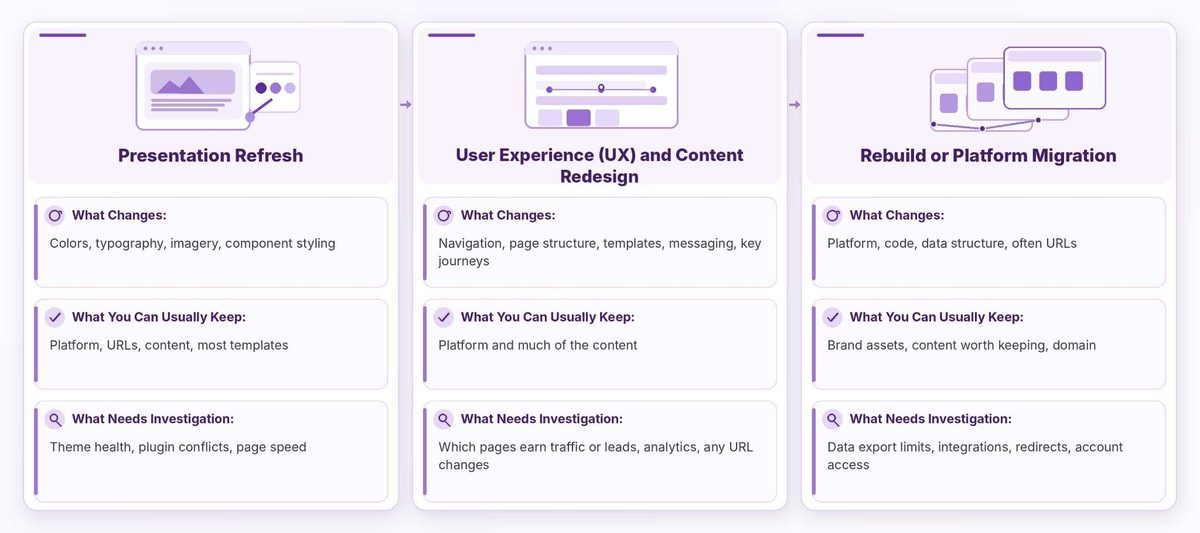
Website revamp cost is easiest to predict at the refresh end and hardest at the rebuild end, because rebuilds uncover what nobody documented. A good website design and development partner should tell you which scope your goals require instead of defaulting to the biggest one.
Looks still matter, but they come after function. Treat current web design trends as optional inspiration, with your customer journeys deciding what fits.
What Has the Biggest Impact on Website Redesign Cost?
The biggest differences in website redesign cost usually sit in the work behind the screens. Eight areas deserve an explicit line in the proposal.
Unique Page Layouts and User Experience
Forty service pages sharing a template can require less effort than a few custom tools. User experience (UX) research, navigation, wireframes, unique layouts, and user interface (UI) design rounds determine the workload.
Good UX/UI design services make revision rounds and approval responsibilities explicit. Ask what happens if requirements change after design approval.
Branding, Copy, and Visual Assets
A redesign isn’t a rebrand. If your positioning still fits, the project can reuse it and focus on structure. If the business has changed (new services, new market, different buyer), settle that first through brand strategy work with its own scope.
Confirm whether copy, photography, illustration, and video already exist or need producing. Content production is often the line missing from the cheaper quote.
CMS Choice and Existing Technical Condition
Keeping a CMS that suits your team is usually cheapest. Costs climb with an unsupported theme, conflicting plugins, or inherited code that must be untangled first, and switching platforms adds migration, retraining, and reconnected integrations.
Editing needs and long-term support should guide platform decisions. For custom tools, choosing the right tech stack also means considering integrations and maintenance; a brochure site rarely needs application-level complexity.
Features and Third-Party Integrations
A contact form is a small task. A booking workflow, customer accounts, advanced search, or a two-way customer relationship management (CRM) sync is a project inside the project, with configuration, data mapping, and testing.
API development services support custom application programming interface (API) work when a ready-made connector cannot handle the required data flow. Confirm configuration, testing, and vendor usage fees before approving the estimate.
Content and Product Data Migration
Migration means auditing pages and media, deciding what’s kept, rewritten, combined, or removed, mapping old fields to new ones, and checking that everything arrived.
Treat customer and order data as a launch dependency. Define which records can move, how accounts will work, and who validates the result. A storefront that looks complete can still fail when a returning customer tries to sign in.
Separate product entry from copywriting and migration. Optimizing product descriptions for SEO belongs in the content scope, with a named owner.
Mobile Experience, Accessibility, and Testing
Define browsers, devices, keyboard navigation, forms, speed checks, and acceptance criteria. Diptyque’s July 2026 migration reported 14% higher conversion and 37% higher checkout completion within three months. These are vendor-published results, not a forecast; they show why testing the buying journey deserves budget.
Accessibility needs the same precision. WebAIM’s February 2026 scan of the top million home pages found detectable failures of the Web Content Accessibility Guidelines (WCAG) on 95.9% of them, mostly basics such as low-contrast text and missing alt text.
Set an agreed WCAG version, conformance level, and testing method. In April 2025, the Federal Trade Commission (FTC) approved an order addressing unsupported accessibility-widget claims. A widget is not a substitute for accessibility work, and testing should not be sold as a legal guarantee.
SEO Migration and Analytics Setup
If URLs change, every old address that earns traffic or links needs a destination. Google advises site owners to map old URLs to new ones, keep redirects for at least a year, and expect temporary ranking fluctuation.
A migration needs SEO services involved before launch: retain useful content, update internal links, and check redirects and indexing. No provider can guarantee unchanged rankings.
Preserve or reconfigure analytics and validate form, call, and purchase events. Follow-up on-site optimization can address page-level issues after launch.
Project Schedule and Approval Process
Agree on content deadlines, decision-makers, and feedback windows. Late changes can affect already-built templates; a fixed launch date still needs enough time for testing.
Elapsed schedule and billable effort are different. Ask which delays alter the fee, and how an accelerated deadline changes staffing and testing.
DIY, Freelancer, or Agency: How the Delivery Model Changes the Budget
Compare equivalent deliverables before prices. Design-only freelance work and an agency project covering development, migration, and testing are different purchases. Confirm the skills, ownership, and support each proposal actually supplies.
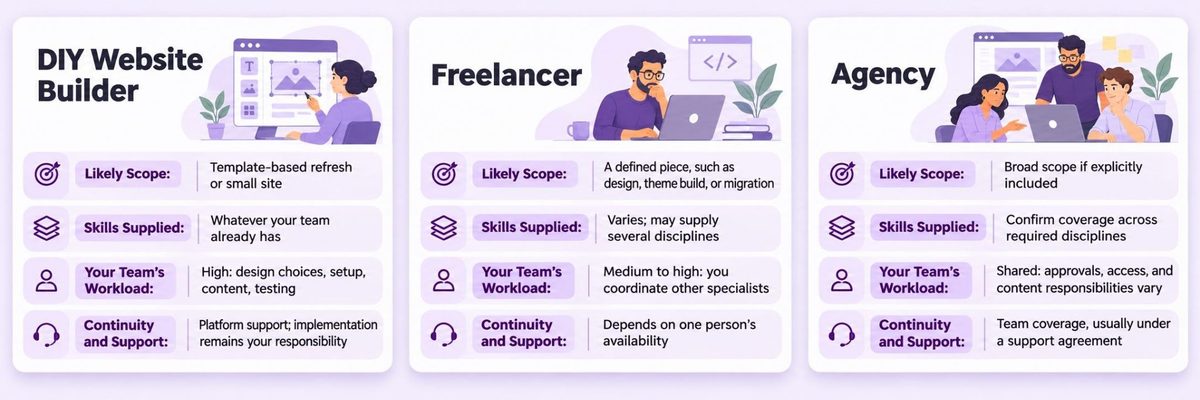
Include your team’s time in the comparison. Specialists can work well for a focused refresh; a coordinated team may suit a redesign spanning several disciplines. Capability and scope matter more than the provider label.
How Platform Choice Changes Redesign and Ownership Costs
Your platform shapes the build and the bills that follow, so treat software, hosting, extensions, and maintenance as separate lines.
WordPress and Other Content-Managed Websites
WordPress software is free; hosting, extensions, maintenance, and support are not. Patchstack’s February 2026 report recorded 11,334 ecosystem vulnerabilities during 2025. That is a reason to budget for maintenance, not evidence that your individual site is compromised.
Shopify, WooCommerce, and Online Store Migrations
Store migrations include catalog structure, apps, supported customer and order records, payment setup, and checkout testing. Check current platform plans and checkout limitations against your requirements; subscription fees are separate from implementation.
Shopify and WooCommerce development should start with your operations and catalog. Compare ownership and maintenance needs alongside features when assessing an e-commerce platform for a small business.
Expenses to Plan for Beyond the Redesign Quote
The quote covers the project; owning the site has its own costs.
Hosting, Licenses, and Ongoing Support
Mark each line as included, billed separately by your provider, or paid directly to a vendor:
- Hosting: Plan level, limits, and who controls the account.
- Domain Renewals: A yearly fee, with the account in your company’s name.
- Paid Tools and Licenses: Themes, plugins, apps, fonts, and stock images.
- Maintenance and Backups: Updates, security patches, backup frequency, and restore time.
- Support: Response times, included hours, and what’s out of scope.
Launch Preparation and Team Handover
Include staging, migration checks, redirect testing, launch support, and editor training. Define the support window and distinguish a delivery defect from a new feature request.
Ongoing Content and Marketing
Recurring SEO, content, and advertising are separate from the redesign. Set those budgets from growth targets and channel costs rather than a fixed percentage of the build.
Can AI Tools Reduce Website Redesign Costs?
AI can assist with draft formatting, repetitive production, and test suggestions. Any savings on your website redesign cost must account for review, accessibility checks, integration testing, and correction work.
METR’s February 2026 update found later productivity estimates were unreliable because of selection and measurement problems. Its earlier study found slower completion for experienced open-source developers. Neither establishes a fixed saving for your redesign.
A prototype can look complete before its business logic, security, and support are ready. That gap explains the hidden cost of vibe coding when custom functionality reaches production.
How to Plan a Realistic Website Redesign Budget
A credible website redesign budget starts from what the site must do, not what a competitor’s site looks like.
Start with Business Goals and a Content Inventory
Define the customer actions the site must support. Inventory existing pages and features, identify what earns visits or leads, and record a baseline for inquiries, sales, and performance.
Separate Must-Haves from Later Improvements
Protect essential journeys and a maintainable core. Reuse suitable components, get content approved early, and phase optional features without cutting testing.
A redesign can also reduce future operating costs. In an October 2026 overview, Dermalogica’s September 2025 theme change was linked to a 40% reduction in developer maintenance time. The detailed case attributes this to replacing custom work with native features. Treat maintainability as part of the brief, not an afterthought.
Compare Quotes Against the Same Scope
When website redesign pricing differs sharply between proposals, check both against this list:
- Templates and Content: How many unique layouts, and who writes and loads the content.
- Migrations and Integrations: Pages, products, customers, orders, and every connected system.
- Testing: Devices, browsers, accessibility standards, and acceptance criteria.
- Exclusions, Responsibilities, and Support: What’s out of scope, what your team supplies, and what happens after launch.
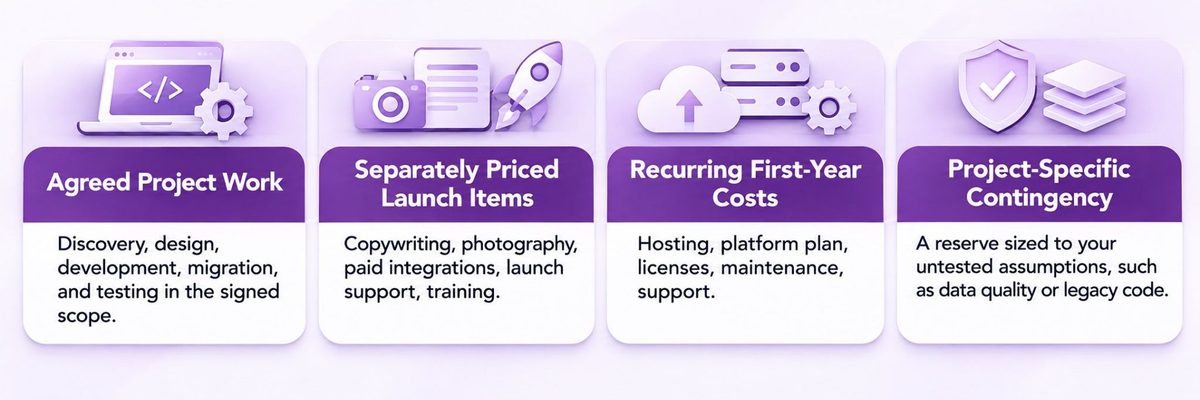
Ask what triggers a change request and which discovery assumptions remain untested. Then total the four lines below, removing anything a proposal already bundles so it isn’t counted twice:
What Real Redesign Projects Can Tell You About Scope
Two Digilite projects show why the cost to redesign a website depends on deliverables, not size.
For the Spartan Blue Knights website project, Digilite handled website development, server-migration certificate issues, and form protection. The engagement also included an email-platform migration. Even a service-business site can involve infrastructure and handover work that a design-only quote misses.
The NorVoch Body Jewelry migration moved a product catalog from WooCommerce to Shopify to address variation management and slow loading. Its scope illustrates a different purchasing decision: easier catalog operations alongside a better storefront. Neither project publishes a budget or quantified conversion uplift.
Plan Your Website Redesign with Digilite
The most reliable way to control website redesign cost is to define scope before anyone prices it. Once goals, content, integrations, and migration needs are clear, an estimate becomes a plan you can approve.
Digilite combines website design and development with relevant content, integration, and migration work. Discovery should establish what your site needs and what belongs in a later phase, so your proposal reflects the business problem.
Share your current site, your goals, and the functionality you need, and discuss your website redesign with our team for a scoped view of what the project involves.
Frequently Asked Questions
1. Is a fixed project fee better than hourly billing for a redesign?
Neither is always cheaper. A fixed fee suits well-defined deliverables, while hourly or phased billing suits projects whose requirements will shift after discovery. Either way, insist on written assumptions, approval points, and a change-control process so extra work is agreed before it’s billed.
2. Who owns the website files, design, and paid licenses after launch?
Your agreement decides, so read the ownership and handover clauses before signing. They should cover source and design files, admin and hosting access, and which licenses transfer. Some themes, fonts, and plugins are licensed to the developer’s account and can’t simply be handed over, so ask for them to be bought in your name.
3. What if my previous developer still controls the domain or hosting?
Resolve access before redesign work begins, since it can change the plan and timeline. Ask your former developer to transfer the accounts or make you the owner, and request a full backup of files and databases. If they don’t respond, use the registrar’s or host’s official account-recovery process rather than any workaround.
4. Will a website redesign affect my business email?
A redesign does not automatically require an email migration. Document the Domain Name System (DNS) records that route your email and have the team preserve or deliberately reconfigure them during launch. Coordinate website, hosting, and email responsibilities before any changes.
5. How should payments be split across a redesign project?
Tie payments to milestones with clear deliverables and acceptance points, such as approved designs, a working staging site, and launch. There’s no universal deposit percentage, so agree on a structure that matches the work and the risk on both sides, and check contract terms with your own legal advisor.