
Search engine optimization (SEO) helps customers discover your business through search. Generative engine optimization (GEO) describes work to make your business and its content useful and discoverable in artificial intelligence (AI) answers. They overlap, but the customer experience and measurement differ.
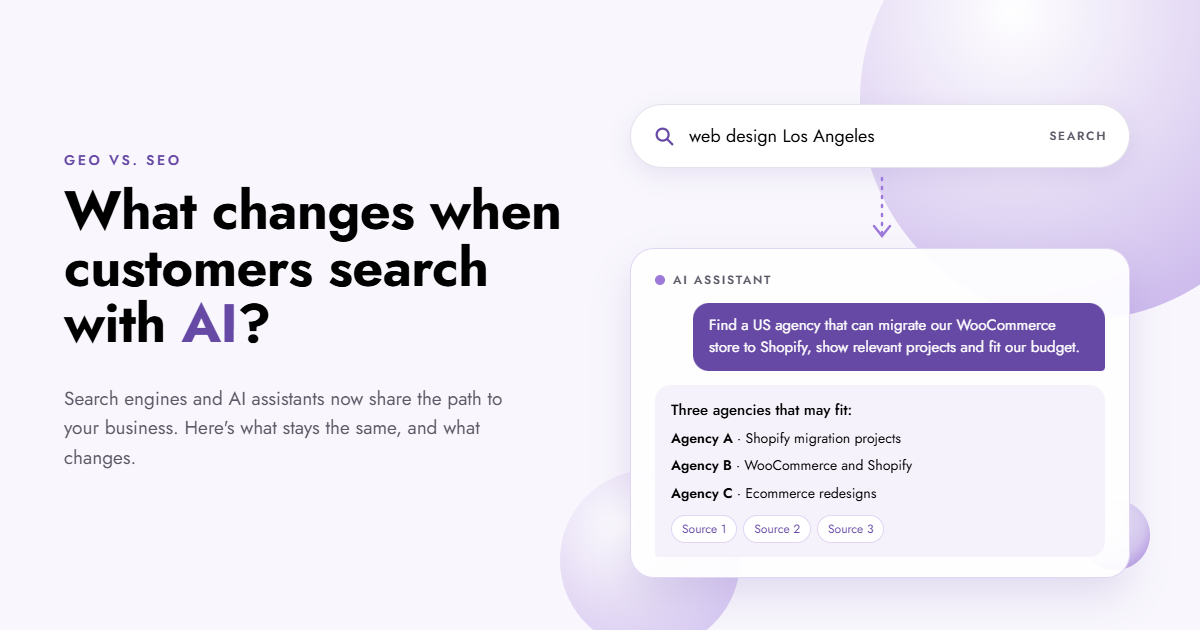
Picture a Los Angeles business owner comparing website agencies. They can search “web design Los Angeles,” or ask an assistant to find agencies that understand Shopify, show relevant projects, and fit a particular budget. Your website needs to help answer both requests.
Understanding GEO vs. SEO helps you decide what to improve first, what evidence customers need, and how to tell whether visibility is producing business.
What Is SEO, and Why Does It Still Matter?
SEO improves how search engines access, understand, and present your website to relevant searchers. It combines technical accessibility, useful pages, credible links, and, for businesses serving specific locations, local visibility.
A strong page connects the search to a decision: what you offer, who it suits, and what happens next. Search engines interpret meaning and intent, so repeating a keyword cannot substitute for answering the question.
That work remains relevant when search results include AI-generated answers.
What Is GEO in AI-Powered Search?
Generative engine optimization focuses on helping accurate, useful information about your business become discoverable within generated answers. That might mean improving a service comparison, publishing firsthand evidence, or correcting conflicting business details.
Three events deserve separate attention: a system retrieves information, an answer mentions your business, or an answer cites your page with a link. Retrieval doesn’t guarantee a mention, and a citation doesn’t guarantee a visit.
For a buyer building a shortlist, however, useful information can influence consideration before they arrive on your website.
GEO vs. SEO at a Glance
The GEO vs. SEO differences concern the discovery experience and what you can measure. Here, GEO means generative engine optimization, not geographic targeting.
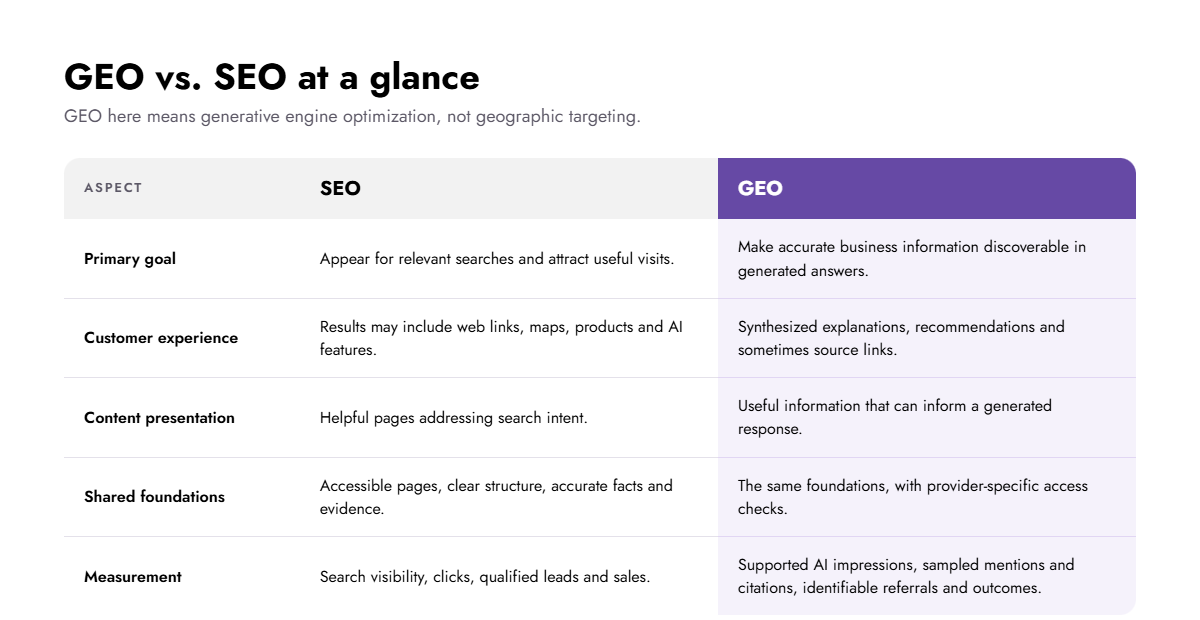
Search results and AI answers increasingly share the same screen. Retaining effective SEO services while testing AI discovery is more practical than treating them as unrelated investments.
GEO vs. SEO: How Search Results and AI Answers Are Created
The systems differ in how they present information. Both depend on having something useful to work with.
How Search Engines Find and Rank Pages
Search engines discover pages, process them for an index, and select results relevant to a query. Meaning, intent, and multiple page and site signals inform what appears.
Ranking is competitive and variable. A technically accessible page still needs to deserve attention.
How AI Search Retrieves and Combines Information
Search-enabled assistants can retrieve sources and combine information into an answer. Google’s AI features may use query fan-out across related searches, investigating subtopics before producing a response.
Live retrieval differs from model training. Not every generated answer searches the web, and a source list should not be read as a complete record of everything influencing an answer.
GEO vs. SEO: How They Address Customer Intent
The change becomes clearer when a customer stops naming a category and starts describing a situation.
From Short Queries to Detailed Conversations
“Website redesign agency” can become “Find a US agency that can migrate our WooCommerce store to Shopify without making product variations harder to manage.”
A follow-up might ask about migration risks or relevant projects. Different platforms handle those conversations differently.
Writing around real questions also supports voice search optimization. Spoken queries and generative AI conversations are distinct experiences, but both reward explanations that sound like answers to customers.
From Search Results to Answers and Recommendations
Walmart’s October 2026 holiday rollout illustrates this shift: Sparky supports meal planning around budget and dietary needs, connecting the situation to recipes and ingredients.
The creative idea is useful assistance at a moment of purchase. A specialty retailer could apply that thinking through an accurate hosting guide or product selector. Walmart’s announcement describes implementation, not a published sales lift.
Customers may still visit source pages to verify recommendations. A mention, a clickable citation, and a completed purchase remain different outcomes.
Where GEO and SEO Overlap
Shared fundamentals give you a sensible starting point before investing in platform-specific experiments.
Accessible, Indexable Pages and Clear Site Structure
Priority information should appear in accessible text, supported by descriptive headings and useful internal links. Product and service facts should match what customers can actually buy.
Practical on-site optimization can address these gaps while improving the visitor’s experience. Google’s 2026 guidance on generative AI search says SEO remains foundational and no special AI markup is required. These are Google’s rules; other providers have their own controls.
Helpful Content Backed by Real Expertise
For Diamond HOA Management, Digilite built a multi-page website and added six service pages following an SEO review. The published project describes stronger service-page rankings without providing numerical traffic or lead results.
The relevant lesson is specificity: give each important service enough explanation to be evaluated. A buyer needs to understand the scope, rather than infer it from “full-service management.”
Firsthand examples, clear authorship where relevant, and supported claims help readers assess expertise. None guarantees an AI citation.
GEO vs. SEO: How to Adapt Your Content Strategy
AI search optimization should make your information more useful to customers. Start with the questions that delay a purchase.
Make Content Easier to Understand and Verify
Consider two hypothetical agency descriptions. “We build amazing websites” gives a buyer little to compare. “Our Shopify migration covers product imports, variation checks, and redirect mapping; custom application development requires separate scoping” explains deliverables and limits.
Apply that clarity to your own pages. Lead with an answer, then explain conditions, evidence, and fit. Date research and results so readers can assess relevance.
The same discipline supports creating engaging and shareable content: offer something specific enough to use or discuss. Repetitive generated pages, fabricated reviews, and unsupported superlatives weaken the case.
Keep Business Information Consistent
Your website, business listings, and relevant profiles should agree on your name, location, services, and product facts. Resolve an old service description instead of publishing more content around it.
Discovery across platforms also shapes social media trends for brands. Keep profiles current and seek legitimate coverage; posting more often does not establish a direct path to AI citations.
Which Does Your Business Need: GEO, SEO, or Both?
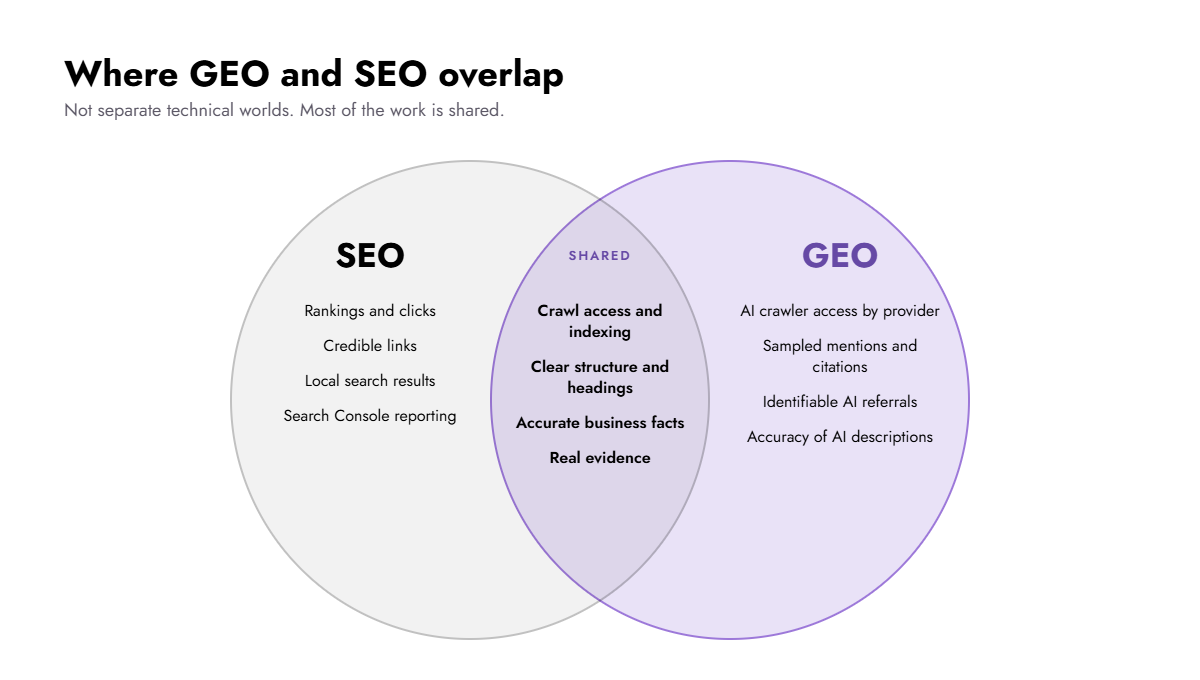
Your baseline determines the work. A business with inaccessible service pages faces a different problem from one with strong search performance and emerging AI referrals.
Decide What to Prioritize Based on Your Customers
Answer four questions before allocating a budget:
- Where do qualified customers currently discover us?
- Which questions do they ask before buying?
- Can people and relevant crawlers access useful answers on our priority pages?
- Which visits become qualified inquiries or purchases?
Fix foundational gaps first, then test AI-discovery improvements alongside ongoing SEO. Budget for the actual content, development, and measurement required; a universal spending split ignores your starting point.
Local Service Businesses
Imagine a homeowner asking for a Glendale electrician who handles panel upgrades and offers appointments after work. Accurate service areas, clear capabilities, and current contact information help them judge fit.
Scheduling claims should reflect real availability. Local SEO services can support those basics without inventing offices, reviews, or service coverage to match a prompt.
Online Stores
A buyer might compare “USB-C docks under $200 that support two monitors with my specific laptop.” Compatibility, price, availability, and returns matter more than generic product praise.
That makes accurate product information central to e-commerce SEO services. A recommendation is only useful if the product meets the requirement.
Amazon’s assistant, then called Rufus and renamed Alexa for Shopping in May 2026, offers a revealing example. In its November 2025 update, shoppers using it were over 60% more likely to purchase during that shopping trip. This is a company-reported association, not proof the assistant alone caused the difference.
The practical takeaway for preparing your e-commerce store for Gemini and ChatGPT is to answer purchase questions accurately. You don’t need Amazon’s technology budget to explain compatibility or product limitations.
Amazon’s 2026 holiday campaign incorporates conversational deal finding, connecting promotional discovery with shopping assistance. At publication, those Black Friday events are upcoming, so this is a campaign example, not a completed-results claim.
For your own catalog, optimizing product descriptions for SEO gives that information a useful home. Keep specifications consistent with your feeds and policies.
How to Measure Progress Without Confusing the Metrics
AI search visibility is useful only when you understand what each signal represents. Keep discovery evidence alongside business outcomes.
Track Search Performance and AI Visibility Separately
Establish organic search clicks and conversions, identifiable AI referral visits, and a small, documented prompt sample. Record the platform, exact prompt, date, US market context, and cited pages.
Google’s Generative AI performance report reports impressions for supported features, including AI Overviews and AI Mode; it may be absent when a site has insufficient impressions. It isn’t a report for every AI assistant.
Sampled answers vary, and some AI-influenced visits won’t carry an identifiable referral. Treat prompt checks as directional observations.
Measure Visits, Leads, and Sales
In September 2026, AI-referred traffic generated 83% higher revenue per visit than non-AI traffic across the US retail sites measured by Adobe. This aggregate comparison is a reason to investigate your own traffic, not a forecast for your store.
Track qualified inquiries, purchases, and revenue by source where possible. Separate a successful worksheet request from a sales-ready lead.
The destination matters, too. In Digilite’s NorVoch Body Jewelry migration, product-variation management problems and slow loading on the previous WooCommerce store prompted a move to Shopify. The project describes easier product management and improved loading speed, without quantified conversion results.
That is relevant delivery experience, rather than a measured GEO case study. An AI recommendation still needs a usable destination. Investing in UI and UX design, meaning user interface and user experience design, helps address the handoff. Visitors need clear product choices and a workable route to purchase.
For stores, improving retail conversion rates belongs alongside visibility reporting. More citations won’t fix a checkout that customers cannot complete.
How to Build a Combined GEO and SEO Strategy
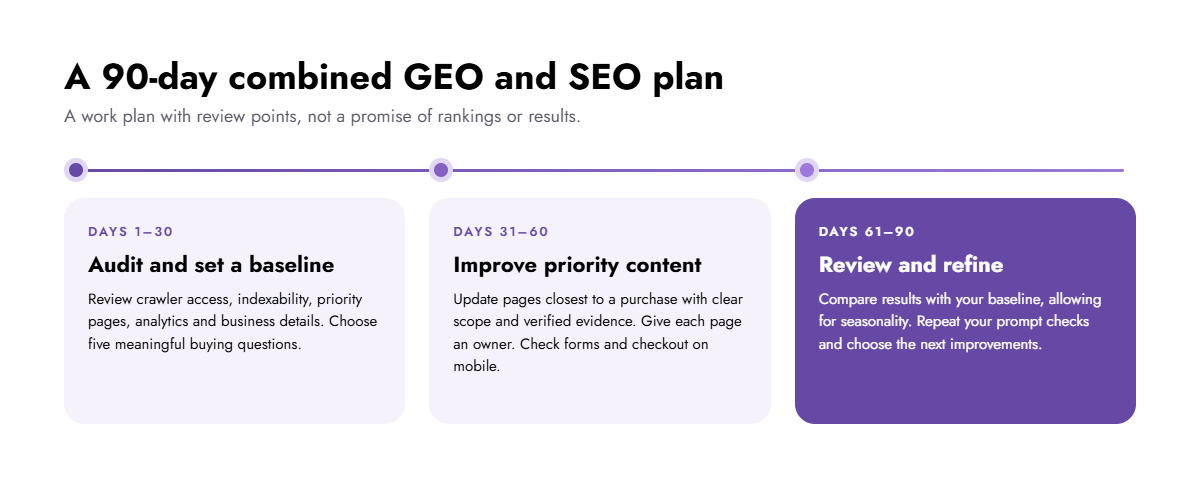
Use a 90-day work plan to sequence improvements. It sets responsibilities and review points, not a deadline for guaranteed results.
Days 1–30: Audit and Set a Baseline
Review crawler access, indexability, priority pages, analytics, and business details. Choose five meaningful buying questions and document what customers currently find.
Across large sites, enterprise SEO services can help prioritize shared templates and coordinate changes. Fixing one template may address a repeated problem across many pages.
Days 31–60: Improve Priority Content
Update pages closest to a purchase with clear scope, relevant comparisons, and verified evidence. Give each page an owner responsible for accuracy.
Check forms and purchase paths on mobile before bringing more visitors in.
Days 61–90: Review and Refine
Compare search and business outcomes with the baseline, allowing for seasonality and other campaigns. Repeat your documented prompt checks and note changes without attributing every sales increase to GEO.
Choose the next improvements based on the gaps you can substantiate.
Build a GEO and SEO Strategy with Digilite
You should be able to explain why customers find you, what helps them choose you, and where the website loses them.
Digilite brings technical SEO, content, and website development experience to that work. Our projects show how clearer service pages and better shopping experiences address different parts of the same customer decision.
To discuss your search visibility, share your website and the question customers ask before contacting you. That gives the conversation a concrete starting point: the information they need and the improvements worth prioritizing.
Frequently Asked Questions
1. Is AEO the same thing as GEO?
Answer engine optimization (AEO) generally describes making content useful for direct answers. It overlaps with GEO, but industry terminology varies; evaluate the proposed work and measurement rather than the label.
2. Does blocking AI training also block AI search?
The controls can differ by provider. OpenAI documents independent controls for GPTBot, used for potential training content, and OAI-SearchBot, used for search; check the specific provider before changing robots.txt.
3. What can a business do if an AI answer gives incorrect information about it?
Check the cited sources, correct inaccurate owned pages and relevant listings, and use the platform’s feedback route where available. Changes may take time to appear, and an immediate correction isn’t guaranteed.
4. Should a business create a separate website just for AI assistants?
A separate AI-facing site isn’t a default requirement. Maintain useful, accessible canonical content first, and evaluate whether a duplicate site would create conflicting information or unnecessary maintenance.
5. Should you remove older blog posts when starting GEO work?
Assess accuracy, usefulness, overlap, and existing performance before deciding. Update, consolidate, or retire individual pages based on evidence; age alone doesn’t establish that a page should go.