

Choosing the right e-commerce platform matters more in 2026 because online selling is no longer just “nice to have.” In the U.S., retail e-commerce sales reached $326.7 billion in Q1 2026, and e-commerce accounted for 16.9% of total retail sales, according to the U.S. Census Bureau.
For small businesses, the platform you choose affects almost everything: setup time, design flexibility, monthly costs, payment options, SEO, inventory management, apps, checkout experience, and how easily your store can grow.
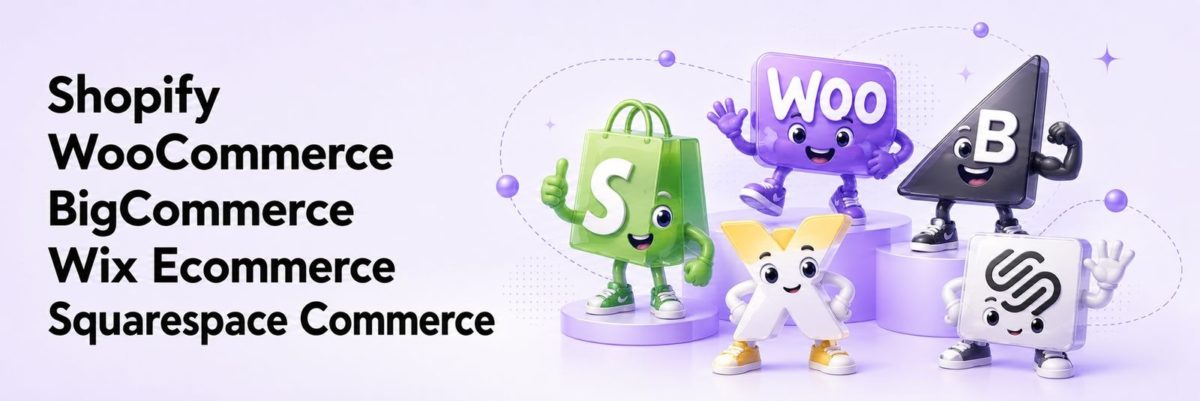
This e-commerce platform comparison looks at the top e-commerce platforms for small businesses in 2026, including Shopify, WooCommerce, BigCommerce, Wix E-commerce, and Squarespace Commerce. The goal is simple: help you compare e-commerce platforms faster and choose the best e-commerce platform for your business stage, budget, and growth plans.
Top E-commerce Platforms Compared 2026
Shopify
Shopify is often the best e-commerce platform for small business owners who want an all-in-one solution. It includes hosting, checkout, payment tools, inventory management, themes, apps, and integrations in one platform.
For many small businesses, Shopify’s biggest advantage is simplicity. You do not need to manage hosting, security updates, or complex technical setup. You can choose a theme, add products, connect payments, and start selling relatively quickly.
Shopify is also strong for B2C e-commerce brands that sell physical products, apparel, beauty products, accessories, home goods, food products, digital products, or subscription-based items. Its app ecosystem makes it easier to add features like email marketing, reviews, loyalty programs, upsells, subscriptions, shipping tools, and advanced analytics.

A famous real-life example is Gymshark, which has used Shopify to support online and offline commerce experiences, including Shopify POS for events and in-person sales. While Gymshark is now a major global brand, its story is often used as an example of how a direct-to-consumer brand can grow with the right e-commerce infrastructure.
Shopify’s main downside is cost. The core monthly plan may look manageable at first, but apps, premium themes, payment fees, and advanced tools can increase the total monthly spend. Shopify’s current pricing page lists Basic, Grow, and Advanced plans at $29/month, $79/month, and $299/month when billed annually, with Plus available for larger businesses.
Best for: Small businesses that want the best all-in-one e-commerce platform with room to grow.
Main strengths:
- Easy setup
- Hosting included
- Strong checkout
- Large app ecosystem
- Good for multichannel selling
- Works well for growing B2C brands
Main drawbacks:
- App costs can add up
- Less open-ended customization than WooCommerce
- Some advanced features require higher plans or paid apps
Digilite has also delivered numerous Shopify projects across different industries, including Aroma Country, First Choice Candy, and Rebel Athletic, with work ranging from custom storefront design and checkout optimization to Wix-to-Shopify and Magento-to-Shopify migrations.
If you also want to build, customize, or migrate your Shopify store, we can help you create an e-commerce website that matches your brand, works smoothly, and supports long-term growth.
WooCommerce
WooCommerce is the best e-commerce platform for businesses already using WordPress or planning to build a content-heavy website with e-commerce included. It is not a standalone platform like Shopify or Wix. Instead, it is a free WordPress plugin that turns a WordPress website into an online store.
The biggest advantage of WooCommerce is control. You own your WordPress site, choose your hosting provider, customize the design, install plugins, edit code if needed, and build a store around very specific business needs. This makes WooCommerce a strong option for businesses that care about SEO, blogging, custom product pages, flexible layouts, and long-term ownership.
WooCommerce can be especially useful for businesses that want e-commerce and content marketing to work together. For example, a skincare brand could publish ingredient guides, product education, comparison articles, and tutorials while also selling products through the same website.
The plugin itself is free, but WooCommerce is not truly “free” once you include hosting, domain, paid themes, extensions, developer help, security, backups, and maintenance. WooCommerce estimates that hosting commonly ranges from $25 to $350/month for most stores, while extensions may cost $29 to $299/year per extension.
WooCommerce also requires more hands-on management. You may need to update WordPress, plugins, themes, payment tools, and security settings. For a business with technical support, that flexibility is a strength. For a beginner who wants the fastest path to launch, it can feel overwhelming.
Best for: WordPress users, content-driven brands, and businesses that want more control.
Main strengths:
- Flexible customization
- Great for SEO and blogging
- Strong WordPress integration
- Large plugin ecosystem
- More ownership and control
- Good for custom e-commerce needs
Main drawbacks:
- Requires hosting and maintenance
- Setup can be more technical
- Plugin conflicts can happen
- Costs vary widely depending on setup
BigCommerce
BigCommerce is a strong e-commerce platform for small businesses that are serious about scaling. It is often a better fit for brands that already have traction, a larger catalog, multiple sales channels, or more complex e-commerce needs.
Compared with Shopify, BigCommerce includes more advanced built-in features, which can reduce the need for extra apps. This can be helpful for businesses that want strong native tools for SEO, product options, promotions, customer groups, and multichannel selling.
BigCommerce is also used by larger and well-known brands. Its own materials mention companies such as Ben & Jerry’s, Molton Brown, S.C. Johnson, Skullcandy, Solo Stove, Ted Baker, and Vodafone among businesses using the platform.
For small businesses, the main question is whether BigCommerce is more than you need right now. It can be powerful, but it may not feel as beginner-friendly as Shopify or Wix. Its pricing is also higher than that of some entry-level website builders. BigCommerce lists Standard, Plus, and Pro plans at $39/month, $105/month, and $399/month, with Enterprise pricing available for larger businesses.
Best for: Scaling small businesses with larger catalogs or more advanced e-commerce needs.
Main strengths:
- Strong built-in e-commerce features
- Good SEO tools
- Less reliance on apps
- Good for larger product catalogs
- Useful for multichannel selling
- Can support more complex growth
Main drawbacks:
- Higher starting cost than some platforms
- Can feel less beginner-friendly
- May be too advanced for very small starter stores
Wix Ecommerce
Wix E-commerce is one of the easiest e-commerce platforms for small businesses that want a simple online store. It is especially useful for beginners who want drag-and-drop editing, built-in templates, and a less technical setup process.
Wix works well for service-based businesses, local shops, small product catalogs, creators, and small B2C e-commerce stores that do not need complex backend systems. For example, a candle brand, bakery, local boutique, handmade jewelry shop, photographer selling prints, or small wellness brand could use Wix to get online quickly.
Wix offers e-commerce templates, store management tools, payment options, multichannel selling features, and AI-assisted website building. Wix’s own e-commerce page highlights rapid store creation, templates, and built-in tools for designing, selling, managing, and growing a store.
The main limitation is scalability. Wix is great for starting simple, but businesses with complex product variations, advanced inventory needs, custom workflows, or aggressive growth plans may eventually outgrow it. It is easier than WooCommerce, but not as e-commerce-focused as Shopify or BigCommerce.
Best for: Beginners and small businesses that want the easiest starter option.
Main strengths:
- Very easy to use
- Drag-and-drop builder
- Good templates
- Beginner-friendly setup
- Works well for simple stores
- Good for small catalogs
Main drawbacks:
- Limited scalability for larger stores
- Less advanced e-commerce depth than Shopify or BigCommerce
- Not ideal for complex product or fulfillment needs
Squarespace Commerce
Squarespace Commerce is a strong choice for design-focused brands that want a clean, polished, professional website with e-commerce built in. It is especially popular with creatives, boutique brands, artists, photographers, interior designers, consultants, and lifestyle businesses.
The biggest advantage of Squarespace is visual presentation. Its templates are clean and modern, making it easier to create a high-end brand feel without heavy design work. This can matter for businesses where photography, packaging, storytelling, and brand experience influence purchase decisions.
Squarespace supports selling physical products, services, digital products, memberships, and more through its commerce tools. Its support documentation says Squarespace can be used to sell services, content, memberships, and physical products online.
The downside is flexibility. Squarespace is simple and visually strong, but it is not the best choice for complex e-commerce operations. Businesses that need advanced inventory management, custom checkout logic, deep app integrations, or large-scale e-commerce automation may find it limiting compared with Shopify, WooCommerce, or BigCommerce.
Best for: Design-first brands that want a polished website and simple e-commerce.
Main strengths:
- Beautiful templates
- Professional visual design
- Simple store management
- Good for creatives and boutique brands
- Strong all-in-one website builder
Main drawbacks:
- Less flexible for complex e-commerce
- Fewer advanced integrations than Shopify or WooCommerce
- Not ideal for large or complicated product catalogs
Quick E-commerce Platform Comparison

Ease of Use
For beginners, the easiest platforms are Wix and Shopify. Wix is very simple because of its drag-and-drop builder. Shopify is also beginner-friendly, but it is more e-commerce-focused, which makes it better for businesses that want to grow beyond a basic store.
Squarespace is also fairly easy to use, especially for design-focused websites, but some users may find its structure less flexible than Wix.
WooCommerce is the most technical because it depends on WordPress, hosting, plugins, security, and maintenance. BigCommerce is not as technical as WooCommerce, but it may feel more advanced than Shopify or Wix because it is built for more serious e-commerce operations.
Easiest: Wix, Shopify
Moderate: Squarespace, BigCommerce
Most technical: WooCommerce
Pricing Overview
Pricing can be tricky because the monthly plan is only part of the total cost. When you compare e-commerce platforms, you should also consider:
- Payment processing fees
- Premium themes
- Apps and extensions
- Email marketing tools
- Shipping tools
- Subscriptions or loyalty apps
- Developer support
- Hosting and security
- Transaction fees
- POS or in-person selling tools
WooCommerce may have the lowest starting cost because the plugin is free, but the final cost depends on hosting, plugins, web design, and maintenance. Shopify, Wix, and Squarespace are usually more predictable because hosting is included. BigCommerce and Shopify can become more expensive as the business grows, but they also offer stronger e-commerce features for serious sellers.
Lowest starting cost: WooCommerce, but extra costs apply
Mid-range: Wix, Squarespace, Shopify
Higher range: BigCommerce and Shopify with apps or advanced features
Best E-commerce Platform for Small Business Needs
The best e-commerce platform depends on what your business actually needs.
- For a beginner launching a small online store, Wix may be enough. It is simple, fast, and easy to manage.
- For most product-based small businesses, Shopify is usually the best overall choice because it balances ease of use, e-commerce features, apps, checkout quality, and scalability.
- For a business that already uses WordPress or wants full control, WooCommerce is a strong choice. It is especially good for SEO-focused brands that plan to publish a lot of content.
- For a business that is already growing and needs stronger built-in e-commerce tools, BigCommerce may be the better long-term option.
- For a design-first brand where visuals matter more than complex e-commerce features, Squarespace Commerce can be a smart fit.
Final Verdict
There is no one-size-fits-all answer when choosing the best e-commerce platform for small businesses. Shopify is a strong all-around choice, WooCommerce offers the most control, BigCommerce is ideal for scaling, Wix is great for simple starter stores, and Squarespace works well for design-focused brands.
The right platform depends on your goals, budget, products, and how much flexibility you need as your business grows.
Need help choosing or building the right e-commerce website? Digilite has experience across many industries and e-commerce platforms, including Shopify and WooCommerce. Our team can help you plan, design, and develop a website that fits your business today and supports your growth tomorrow.
Explore Digilite’s Shopify and WooCommerce development services
FAQs
What is the best e-commerce platform for small businesses in 2026?
Shopify is the best overall e-commerce platform for most small businesses in 2026 because it is easy to set up, built specifically for e-commerce, and scalable as the business grows. Wix is better for very simple beginner stores, WooCommerce is better for WordPress users, BigCommerce is better for scaling, and Squarespace is best for design-focused brands.
Is Shopify better than WooCommerce?
Shopify is better if you want an easier, hosted, all-in-one e-commerce platform. WooCommerce is better if you want more control, more customization, and already use WordPress. Shopify is simpler to manage, while WooCommerce is more flexible but more technical.
Which e-commerce platform is the cheapest?
WooCommerce can have the lowest starting cost because the plugin is free, but it still requires hosting, a domain, security, themes, extensions, and possible developer support. Wix and Squarespace can be affordable for simple stores. Shopify and BigCommerce may cost more, but they include stronger e-commerce features.
Can I switch e-commerce platforms later?
Yes, you can switch platforms later, but it can be time-consuming. You may need to migrate products, customer data, orders, URLs, images, blog content, apps, and SEO settings. It is better to choose carefully from the beginning so you do not need a major migration too soon.
Shopify is the best overall e-commerce platform for most small businesses in 2026 because it is easy to set up, built specifically for e-commerce, and scalable as the business grows. Wix is better for very simple beginner stores, WooCommerce is better for WordPress users, BigCommerce is better for scaling, and Squarespace is best for design-focused brands.
Shopify is better if you want an easier, hosted, all-in-one e-commerce platform. WooCommerce is better if you want more control, more customization, and already use WordPress. Shopify is simpler to manage, while WooCommerce is more flexible but more technical.
WooCommerce can have the lowest starting cost because the plugin is free, but it still requires hosting, a domain, security, themes, extensions, and possible developer support. Wix and Squarespace can be affordable for simple stores. Shopify and BigCommerce may cost more, but they include stronger e-commerce features.
Yes, you can switch platforms later, but it can be time-consuming. You may need to migrate products, customer data, orders, URLs, images, blog content, apps, and SEO settings. It is better to choose carefully from the beginning so you do not need a major migration too soon.