
AI is changing Black Friday marketing in two ways: shoppers use assistants to research and compare deals, while marketers use AI tools to plan, personalize, and optimize campaigns. In 2026, assistants are more likely to help shoppers decide what to buy than to complete the purchase for them.
Imagine someone asks, “What’s the best laptop deal under $800 for editing 4K video, and can I get it by Friday?” Your $779 laptop looks like a fit. But the product page says “up to 32 GB RAM,” the sale price applies only to the 8 GB model, and delivery depends on the ZIP code. A shopper could see your deal in an AI answer and still have no idea whether it meets their needs.
That’s the practical challenge this Black Friday. Can someone understand, verify, and buy the exact deal you’re promoting? Here’s how to test it before shoppers do.
AI Black Friday Marketing in 2026 by the Numbers
AI referrals are growing, and surveys suggest shoppers are more comfortable asking for help than handing over checkout.
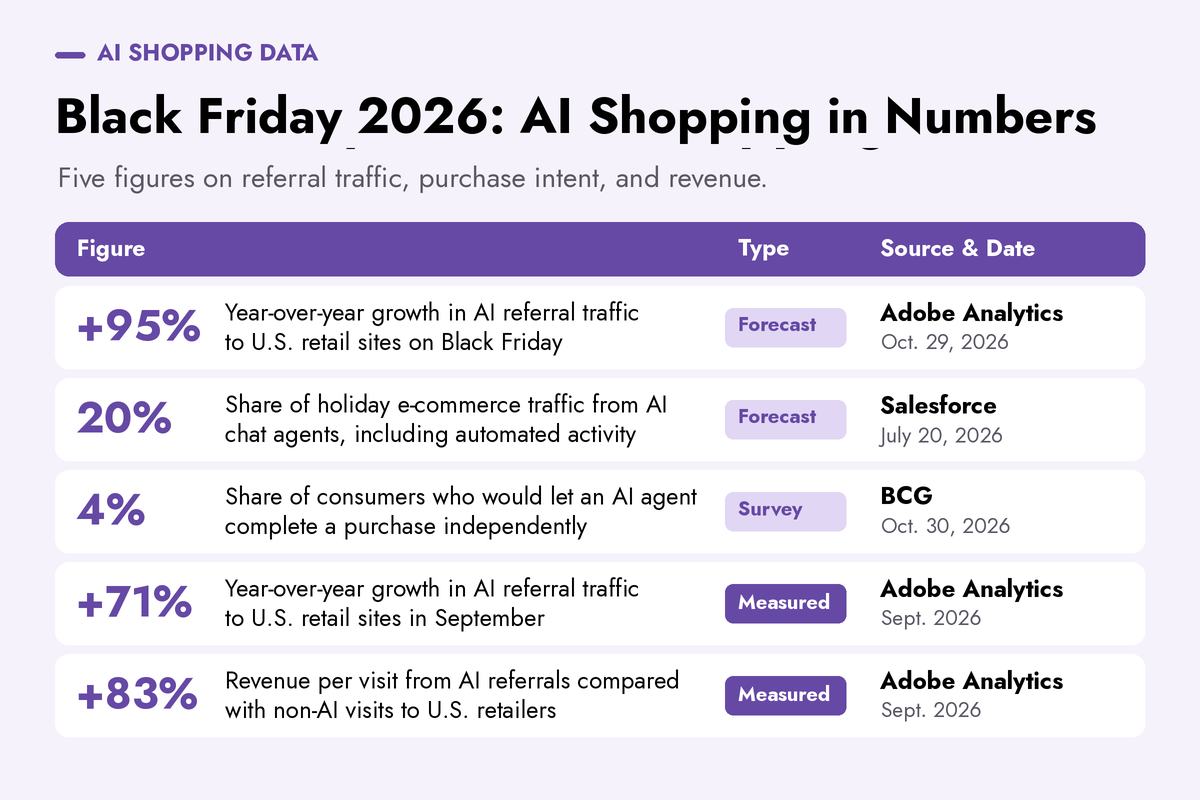
The figures measure different things. Salesforce’s forecast includes backend activity and competitor scrapers, so 20% is broader than human visits sent by shopping assistants. BCG’s 4% reflects what consumers said they would allow. For your campaign, the immediate opportunity is to make the short list and give shoppers enough information to act.
How Shoppers Use AI to Find Black Friday Deals
Shoppers use AI shopping assistants to narrow a search, compare prices and specifications, and ask follow-up questions about delivery, warranties, or returns.
The laptop shopper might start with a budget and then ask whether the memory is upgradeable, how much storage is included, or who covers a return after opening the box. Each follow-up can change the short list. If your $779 model is an open-box unit with a different warranty, that detail belongs near the offer, where the shopper can weigh it against a new unit.
Retailers are building those conversations into their own stores. Walmart expanded Sparky for the 2026 holidays and showed how shoppers can ask for decorations under a budget in Spanish. In Amazon’s 2026 Black Friday and Cyber Monday campaign, shoppers can ask Alexa for shopping to track a price or check its history. The campaigns show how a shopping query can become more specific over several turns or continue after the shopper leaves.
AI Shopping Assistants vs. AI Shopping Agents
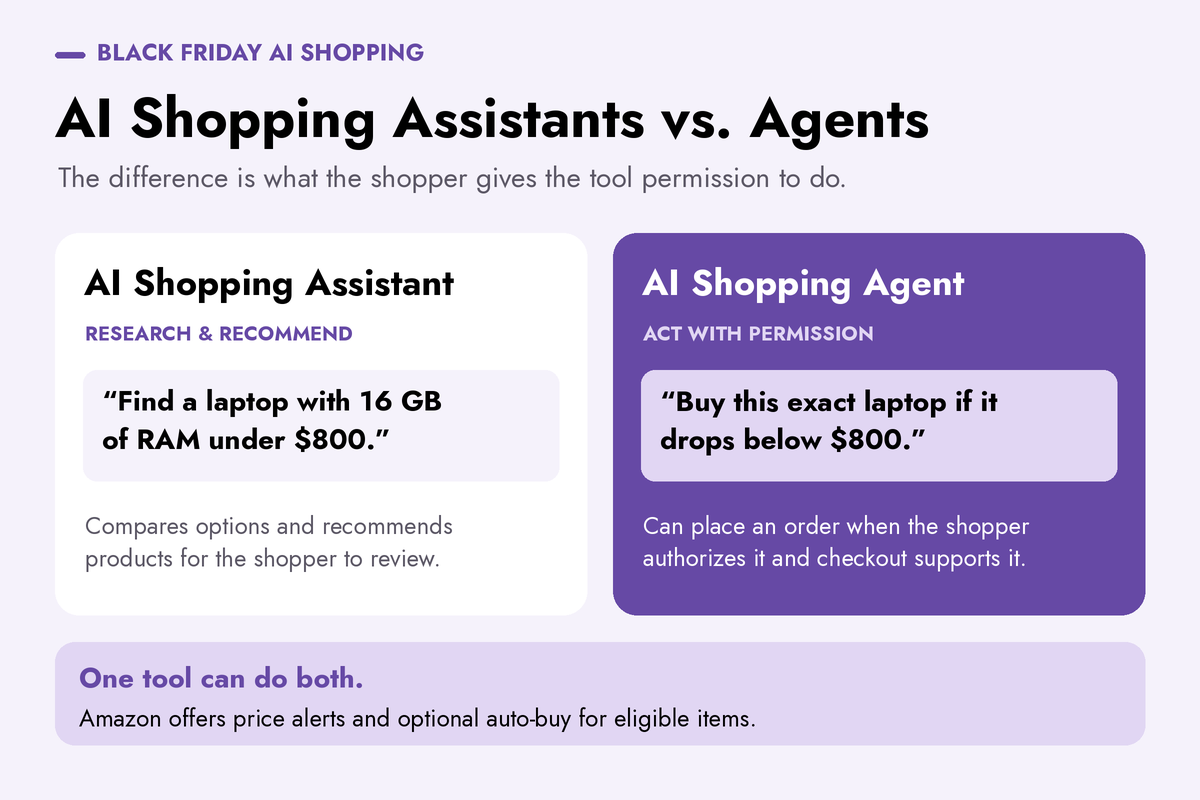
An AI shopping assistant researches and recommends products, while an AI shopping agent can take actions for the shopper, including placing an order where supported.
Think of the difference in terms of permission. “Find a laptop with 16 GB of RAM under $800” asks for research. “Buy this exact laptop if it drops below $800” authorizes an action, subject to the platform’s controls and checkout support. A single tool can offer both capabilities. Amazon, for example, offers price alerts and an optional auto-buy feature for eligible items.
BCG’s research shows why discovery deserves most of your attention this season. Consumers reported a greater willingness to use AI earlier in the shopping journey, and few said they’d let it complete a purchase independently. Third-party agent support also varies by retailer and platform, so confirm what a tool can actually do with your catalog and checkout before basing a campaign on it.
Why Brand Visibility in AI Answers Matters
AI search visibility matters because an unbranded shopping question gives the assistant a role in deciding which products and stores the shopper considers.
Forbes reported in November 2026 that Profound’s research found 60% of AI shopping queries began without a specific brand name. That figure describes the research cited by Forbes. Your own shoppers may search differently depending on what they buy and how familiar they are with the category.
A mention is when an answer names your product or business. A citation is when it points to a source, which could be your product page, a marketplace listing, or a review. A referral is when someone clicks through to your site. A shopper can see a recommendation, remember the name, and visit later through a regular search. Those are three different outcomes to track.
A smaller seller can answer questions a broader listing leaves open. An independent refurbished laptop shop, for instance, can publish the exact model, tested battery capacity, charger included, cosmetic grade, and warranty. A shopper weighing two similarly priced listings now has something concrete to compare. Digilite’s SEO services help establish the foundation by making pages easier to find and understand.
How to Prepare Your Store for AI-Assisted Shopping
Start with your priority deals and check whether a shopper can verify the same product, price, and terms wherever they encounter the offer.
Keep Product Data Accurate and Consistent
Check the exact variant across the product page, structured data, product feed, marketplace listing, and checkout before the sale goes live.
For the $779 laptop, write down the SKU, RAM, storage, condition, sale price, stock status, and the time the offer expires. Check when each feed refreshes. If a scheduled discount goes live at midnight but the feed updates later, the old price can linger where shoppers discover the product. Assign a person to check the launch and the price revert after the sale.
Product structured data can make details like price and availability machine-readable. Keep the markup consistent with what the shopper sees. Digilite’s e-commerce SEO services and guide to optimizing product descriptions for SEO cover the catalog work that supports this.
Answer the Questions Shoppers Ask Before Buying
Build comparisons and gift guides around the conditions shoppers use to rule products in or out.
For laptops, a useful comparison might separate casual editing from work with large video files and show the memory, storage, and ports in each option. For gifts, group products by budget, recipient needs, or compatibility. Use your search terms, customer support logs, and returns reasons to decide which questions deserve an answer. Digilite’s guide to preparing your e-commerce store for Gemini and ChatGPT goes into more detail.
Make Deal Information Easy to Find
Give your campaign a stable page with the offer, eligible products, dates, and exceptions written in visible text.
Above the first product grid, say when the sale starts and ends, whether a code is required, and which items qualify. Place delivery restrictions, returns, or member-only terms close to the relevant offer. If Friday delivery depends on an entered ZIP code, tell shoppers where to check it. Test a qualifying product from the campaign page through checkout and confirm the displayed offer is honored at payment. These details are part of on-site optimization.
Decide Which AI Crawlers Can Access Your Site
Review crawler access provider by provider because some offer independent controls for search and model training.
OpenAI documents separate controls for OAI-SearchBot, which supports search, and GPTBot, which relates to model training. Have your development and SEO teams check robots.txt and any firewall or CDN rules against the current provider documentation. Verify public deal and product pages can be reached under your chosen policy, and keep private customer or order information behind authentication.
How Marketers Can Use AI Tools During Black Friday
Use AI marketing tools for Black Friday to draft, test, and respond faster, with a person responsible for the offer, product facts, and spending decisions.
Campaign Planning and Content Production
Give your AI tool approved campaign facts and use the drafts to test different reasons to buy.
For one laptop offer, test a message about the price, another about the confirmed specifications, and a third about delivery where available. Apply the same approach to email subject lines. Have someone compare every variation against the source offer and check that tone, features, dates, and exclusions match before publication. Digilite’s guide to creating engaging and shareable content offers ways to build on an approved draft.
Personalization and Customer Support
Use consented customer data to make product recommendations more relevant and give support bots a clear path to a person. A buyer who recently purchased a camera might appreciate a compatible memory card. A shopper asking about a delayed order needs an accurate status from an authorized system. Have the bot hand off exceptions, uncertain delivery promises, and refund disputes, with enough context that the customer can pick up where they left off.
Automated Ad Bidding and Budget Management
Let automated bidding respond to auction signals within the spending and profitability limits you set before launch.
Platforms can adjust bids and select creative based on campaign goals. Set a spending limit your business can absorb, check the platform’s budget rules, and decide who can pause campaigns if inventory, product pricing, or tracking changes. Google Ads, for example, explains that an average daily budget can allow higher spending on individual days. If you’re optimizing for revenue, check that the platform isn’t sending more traffic to orders that contribute very little after discounts and fulfillment.
Offer and Pricing Decisions
Use AI to compare offer scenarios and approve each one against real order economics before it goes live.
Ask the tool to model a bundle, a threshold discount, or a free accessory using your actual cost assumptions. A laptop bundle might help clear accessories, but extra shipping or a low-margin charger could wipe out the benefit. Confirm the calculation independently, include fees and fulfillment costs, and test how offers combine in checkout.
Risks to Watch
Review every generated claim for accuracy, urgency, authenticity, and appropriate use of customer information.
A draft can quietly upgrade “up to eight hours of battery life” to “lasts all day,” turn an estimated delivery date into a guarantee, or add scarcity that inventory cannot support. Use real reviews with permission where needed, check applicable disclosure requirements, and avoid pasting identifiable order or customer details into an unapproved tool. Keep an approved product and offer record that everyone can check quickly when the campaign changes.
How to Measure AI’s Impact on Black Friday Results
Track identifiable referrals and sales separately from how often your store appears in a sample of AI answers. In analytics, group recognizable AI referral sources where available and compare sessions, conversion rate, and revenue per visit. Adobe found 83% higher revenue per visit for AI-referred traffic than for non-AI traffic in its September 2026 U.S. retail data. Use that comparison to frame a question about your store, especially if your sample is small or driven by one large order.
Keep a simple prompt log. Try five unbranded questions that reflect actual buying decisions and record the platform, exact prompt, date, brand mentioned, cited page, and whether the price matches your store. Repeat after the offer goes live. If prompts regularly surface a sold-out variant, fix the mismatch. If visitors arrive and leave around the shipping step, review that part of checkout with your UI and UX design team. Digilite’s guide to improving retail conversion rates can help you choose what to test.
Someone who gets a recommendation and visits later through search or a bookmark may never appear as an AI referral. A short post-purchase question can give you another signal. Keep that response separate from click-based attribution so you can see what each method captured.
Get Ready for AI-Assisted Holiday Shopping With Digilite
Start with one offer; your customers would ask an assistant to compare and follow it from the product feed to checkout.
Bring the offer terms and a handful of priority products. Digilite can help identify gaps in product content, technical SEO, and the shopping experience that make the deal harder to discover or buy. When you’re ready, talk to our team about your holiday campaign.
FAQs
1. What Is Agentic Commerce?
Agentic commerce uses AI to carry out shopping tasks on a customer’s behalf within agreed permissions. In Black Friday 2026, that might mean monitoring an item for a target price or placing an eligible order when that price is reached.
2. Will AI Shopping Agents Replace Online Stores?
Stores still provide catalog, stock, pricing, checkout, and fulfillment information that shopping agents depend on. Merchants also handle issues after purchase, including exchanges and warranty claims.
3. Can Small Businesses Show Up in AI Shopping Answers?
Yes. A specialist can give assistants and shoppers useful facts, such as which models a replacement part fits, where pickup is available, or what a warranty covers. Inclusion varies by platform and query.
4. Should You Use AI to Write Black Friday Product Descriptions?
AI can draft a product description from approved specifications. Have a person check the variant, claims, and brand voice, especially when the offer includes a refurbished item or a different accessory.
5. Do AI Chatbots Help Increase Black Friday Sales?
Chatbots can help shoppers move forward by answering routine questions quickly during busy periods. Their value depends on answer accuracy and how easily customers can reach someone when their situation needs more attention.
6. How Do You Know if Shoppers Found You Through AI?
Check analytics for identifiable referrals and add an optional checkout or post-purchase question about how customers heard about you. The two signals can help distinguish people who clicked through directly from people who first researched elsewhere.