
A Black Friday marketing strategy is a plan that connects your sales goal, audience, offer, timing, and channels. A strong strategy for 2026 starts early, protects your margins, keeps product information accurate, and gives shoppers a website that can turn extra traffic into orders.
Picture your Monday report. Sales are up, your best seller sold out, and one of your most popular orders lost money after the discount, shipping, and ad costs. Meanwhile, a shopper who asked an AI assistant for a gift recommendation landed on a page with last week’s price. Both problems started before the first promotional email went out.
Black Friday 2026 falls on November 27, followed by Small Business Saturday on November 28 and Cyber Monday on November 30. Shoppers now research deals through AI assistants as well as search and social media. These seven lessons give each stage of the sale a job, from choosing what to promote to deciding which buyers to follow up with in January.
Black Friday Marketing Strategy at a Glance
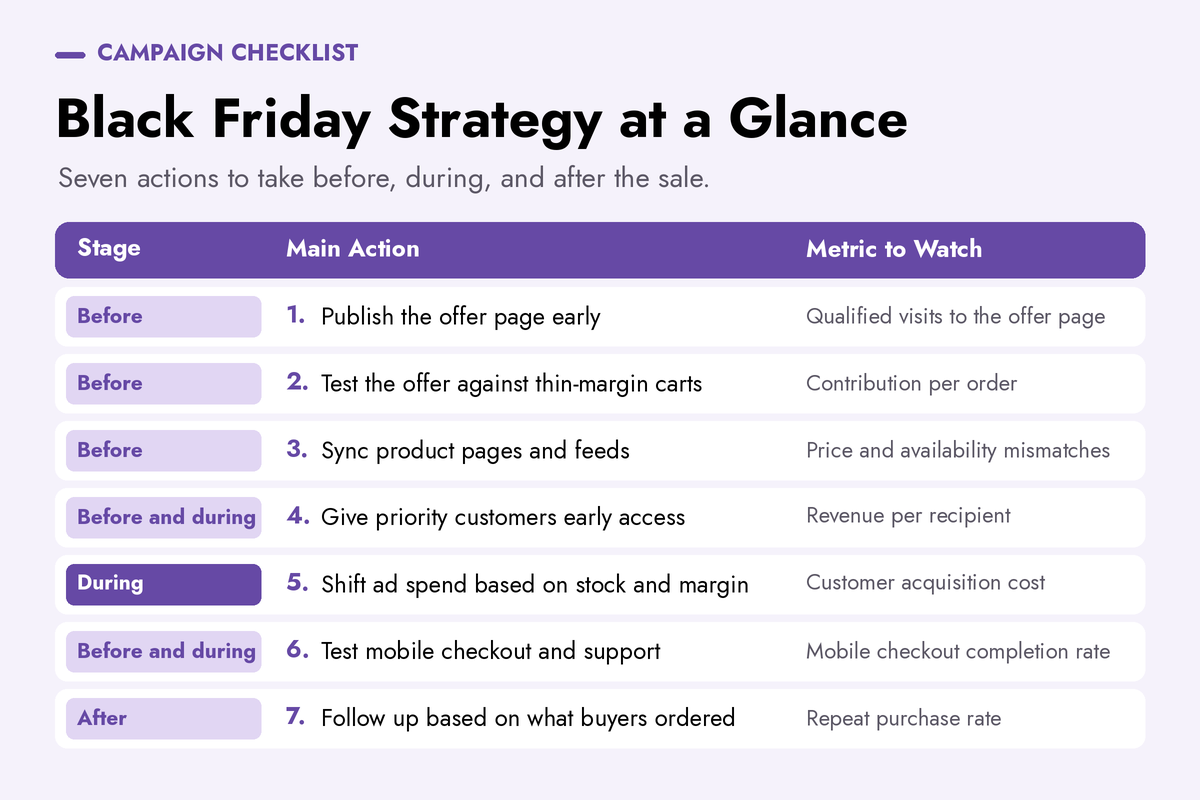
Why Black Friday Planning Looks Different in 2026
In Similarweb’s U.S. data, search volume for terms tied to “Black Friday deals” rose 196% from September to October 2025, before the November peak. By the time many stores send their launch email, shoppers have already started comparing products and prices. Retailers can use early November for discovery and selected offers, then carry a consistent promotion through Cyber Monday.
Adobe’s September forecast projects $12.9 billion in U.S. online spending on Black Friday and $15.1 billion on Cyber Monday in 2026. Adobe also expects AI referrals to grow during the holidays. For a smaller store, the practical choice is which products deserve a longer run and which need a short window because stock, fulfillment, or margin is tight.
Lesson 1: Start Earlier Than Black Friday Weekend
Have your priority products, offer page, and first emails ready several weeks before Black Friday so shoppers can find them while they are still comparing options.
Start with the categories you can keep in stock and explain them clearly. Give each one a role. A best seller might bring in new buyers, a bundle might raise order value, and a replenishable item might give existing customers a reason to come back. Then prepare the content, build the email segments, and test ad creative around those products.
A Black Friday Campaign Timeline for 2026
If you’re building the campaign in late November, cut scope first. Pick one offer you can fulfill, publish one page that explains it, and test one mobile purchase from ad click to confirmation email. Use the remaining time to check product availability and prepare customer support. A small campaign with clear terms is easier to run when several people are also packing orders or answering delivery questions.
Lesson 2: Build an Offer That Protects Your Margins
Choose the offer your lowest-margin eligible cart can support after discounts, fulfillment, payment fees, and acquisition costs.
When comparing Black Friday marketing ideas, start with the cost of the offer. A blanket discount is easy to explain and expensive on products with little room to spare. A bundle works when complementary items have enough combined margin. A gift with purchase can feel generous when its perceived value exceeds what it costs you to ship. A spending threshold can encourage customers to add an item, while early access can reward subscribers without a deeper discount.
Say an item sells for $120 and costs $89. Shipping and fulfillment cost $9, payment fees are $4, and paid acquisition costs $8. That leaves $10 in contribution before overhead and returns. If your sale takes 15% off orders of $100 or more, this item qualifies by itself. The $18 discount takes that order from about $10 of contribution to an $8 loss, assuming the other costs stay roughly the same.
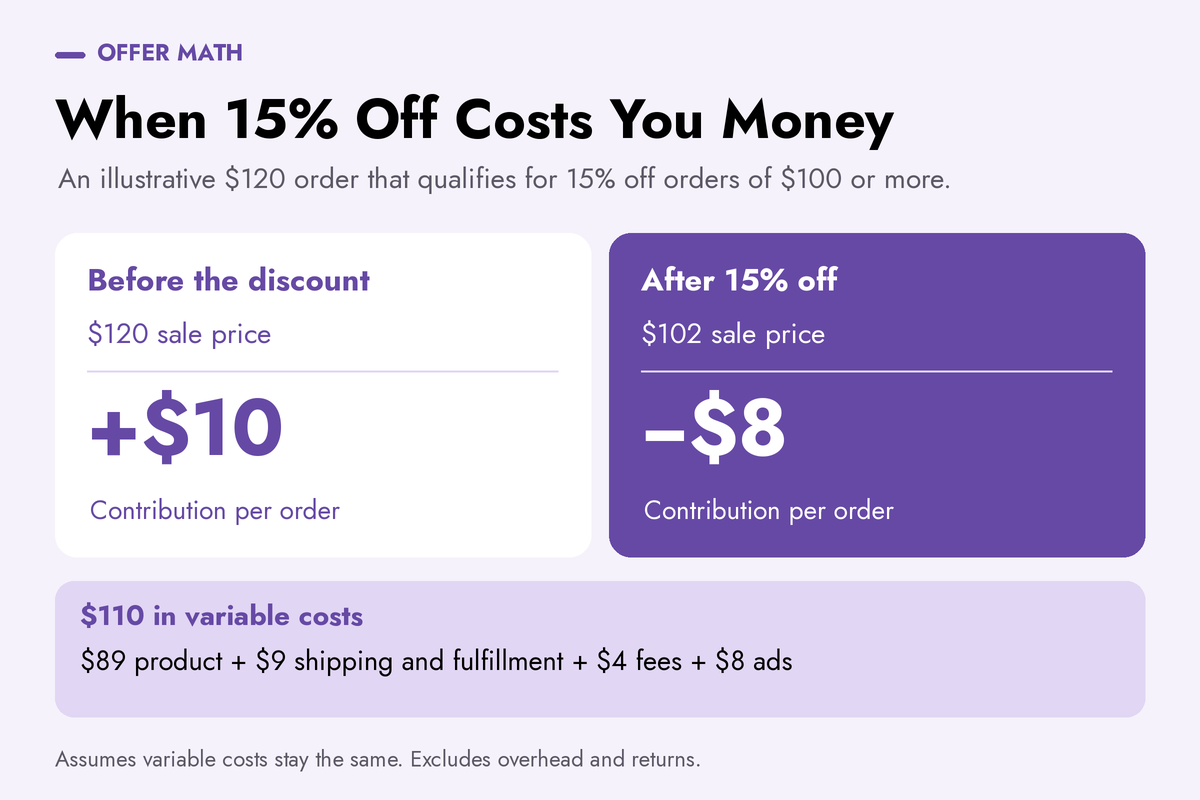
Run that calculation on your thinnest-margin product, a likely two-item cart, and a cart where a customer stacks a code or qualifies for free shipping. Then decide whether to exclude a SKU, build a curated bundle, or change the threshold. If the math still fails, consider an offer with limited inventory or a loyalty perk.
REI took a different approach with its 2026 #OptOutside campaign, announcing a Black Friday store closure and giving employees paid time off. Its campaign centers on something customers already associate with the brand. A specialty retailer could apply that idea with a member repair clinic or an in-store fitting event that gives shoppers a reason to visit without discounting the whole catalog.
Lesson 3: Make Your Products Easy for AI Assistants to Understand
Put product specs, prices, availability, delivery cutoffs, and return terms in readable page text and keep them consistent with your product feeds.
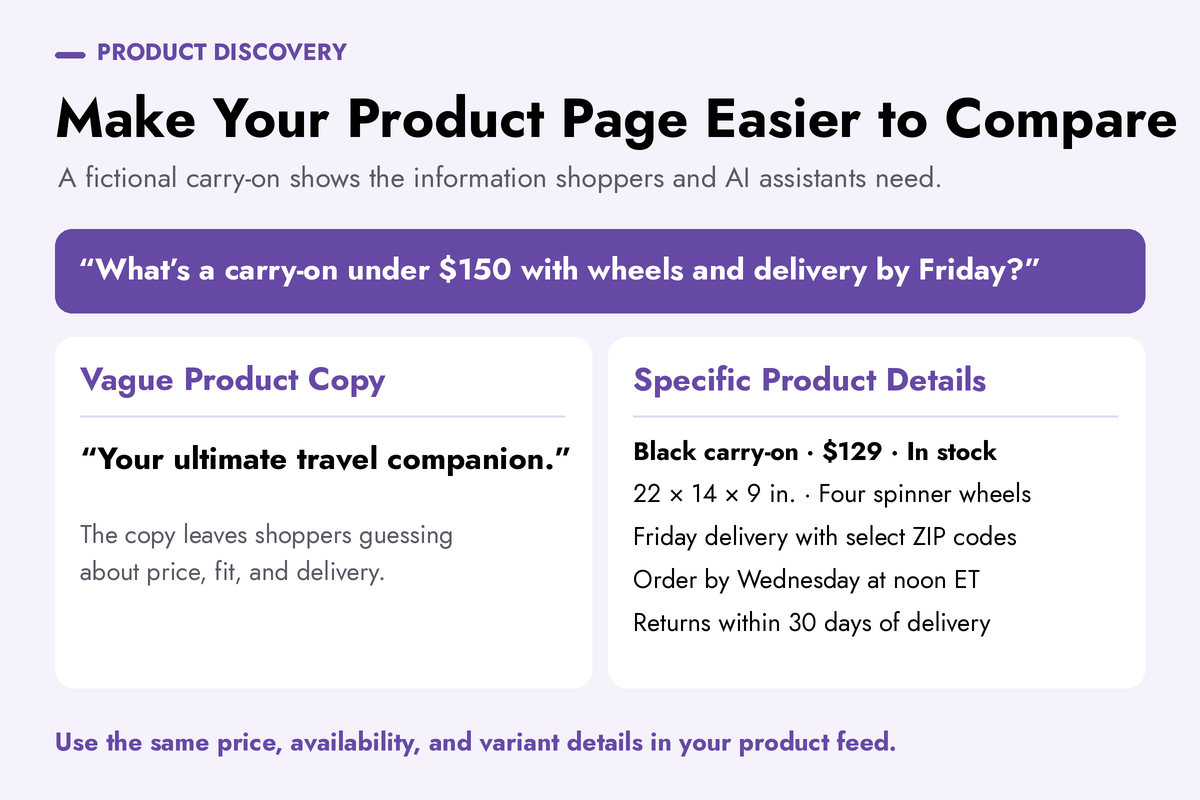
Think about the question a shopper would actually ask ChatGPT or Gemini: “What’s a carry-on under $150 with wheels and delivery by Friday?” A product page that says “your ultimate travel companion” leaves out the facts needed to compare it. Give shoppers exact dimensions, the price of each variant, and the conditions behind delivery estimates. For a deal that applies to select colors or sizes, say which ones qualify.
Amazon made conversational shopping part of its November 19–30, 2026 Black Friday Week and Cyber Monday campaign. Amazon says customers can ask Alexa for shopping to monitor an item for a price drop or view its price history. Walmart also offers its Sparky shopping assistant. Each tool has its own product discovery process, so prioritize clear information on the pages and feeds you control.
Start with the five products you expect to promote hardest. Check the live page and your feed or Merchant Center side by side. Fix any disagreement on sale price, availability, or the exact variant pictured, then test the page on mobile. Digilite’s guide to preparing your e-commerce store for Gemini and ChatGPT can help you work through the rest of the catalog.
Lesson 4: Use Email and SMS for Your Most Valuable Customers
Give loyal customers and interested subscribers a reason to act early, then tailor reminders to what they’ve browsed or bought.
Walmart’s 2026 holiday schedule shows how that can work. Some of its November 12 deals opened to Walmart+ members first, with remaining inventory opened to everyone the next day. The benefit was time to shop selected items. A smaller store could give past buyers first access to a limited gift set or let subscribers reserve a popular size before public launch.
For Black Friday email marketing, plan a teaser, early access, the public launch, a reminder, a last-chance send, and a thank-you. Recent purchasers can skip repeat sales reminders and receive a delivery or product-use message. For subscribers who haven’t bought, give each message a reason to exist, such as a gift recommendation, an answer about fit, or a genuine deadline.
Use the subject line to give readers the offer and deadline when both matter. “Members Get First Pick Through Thursday” tells customers more than “Our Biggest Secret Is Here.” Save SMS for short, timely reminders to people who opted in to texts. Check abandoned-cart emails and texts for expired codes, sold-out items, and overlap with your regular campaign sends.
Want help finding the gaps between the offer, the product pages, and checkout? Talk through your Black Friday plan with Digilite. Bring your priority products and the offer you’re considering so the conversation can focus on where shoppers are likely to get stuck.
Lesson 5: Plan Paid Ads Around Rising Competition
Test Black Friday ads before the busiest days, then shift budget according to stock, acquisition cost, and the contribution each order can support.
Auction competition can intensify when more retailers promote at once. Set daily budget limits, and decide in advance what would justify increasing spending. In the earlier $120 product example, the cart had only $10 available before considering overhead and returns once the listed costs were paid. Sending more paid traffic to the discounted version would deepen the loss unless something in the economics changed.
Build audiences ahead of launch. Where eligible, retarget recent site visitors and cart abandoners with an ad that addresses their next question. A shopper who left a product page may need to see how the item fits or works. Someone who left at checkout may need the actual shipping threshold stated clearly. Use customer reviews or customer photos you have permission to feature, and make sure the creative matches the product and the offer it links to.
Set a check-in cadence your team can maintain. Pause ads for sold-out variants, swap deadline copy when the offer changes, and confirm the promotion still applies on the destination page. Track acquisition cost and margin alongside platform-reported return on ad spend.
Lesson 6: Fix the Post-Click Experience Before Traffic Arrives
Build a Black Friday landing page that answers purchase questions quickly and test the entire path from mobile ad click to completed order.
Put the offer, dates, terms, exclusions, and shipping deadlines in page text. Give visitors one obvious next step, such as shopping eligible products. On the product page, show selectable sizes and colors with current availability. In checkout, make it easy to spot shipping charges and confirm that a discount actually applied.
One of the easiest Black Friday marketing tips to act on is to test a real cart. Ask someone unfamiliar with the campaign to make a test purchase on their phone. Can they find an eligible product, tell when it should arrive, and see the discount without asking for help? Test a qualifying cart, a below-threshold cart, and a sold-out variant. If it takes three screens to understand why a code failed, fix the message while your team has time to review it.
In the NorVoch Body Jewelry migration, Digilite moved the product line to Shopify to make the store easier to manage and reported improved loading speed. The example illustrates why catalog management and site performance belong on the same readiness checklist. Digilite’s UI and UX design services can help address the places where shoppers hesitate or drop out.
Give customer support the same deal terms shoppers see. Prepare short answers for order changes, delivery estimates, and holiday returns, and name who can update the website when something changes. A clear stock or shipping update can prevent the same question from filling the inbox all weekend.
Lesson 7: Turn Black Friday Buyers into Repeat Customers
Use post-purchase messages and a January follow-up to give Black Friday shoppers a reason to buy again based on what they ordered.
Start with an order confirmation and useful delivery updates. After delivery, send one thing that helps the customer enjoy the purchase, such as setup instructions, sizing advice, or a care guide. Ask for a review after they’ve had a chance to use it, and invite customers to join your loyalty program if it offers benefits relevant to the purchase.
In January, group buyers by what they ordered and why they might return. Someone who bought coffee beans may be ready for a refill. Someone who bought a grinder may want a quick guide to dialing it in. Use customer questions to plan educational posts too. Digilite’s guide to social media trends for brands can help you choose formats for that content.
How to Measure Your Black Friday Results
Set a primary goal before the sale. If your goal is profitable acquisition, use first-time customer contribution and acquisition cost. If your goal is clearing seasonal inventory, track sell-through and the margin you recovered. Choose comparable dates when reviewing last year’s performance, such as Black Friday through Cyber Monday in each year.
Use consistent UTM tags on campaign links across ads, email, SMS, and social. Review revenue, contribution after variable costs and refunds, new versus returning customers, and sales by channel. Pull actual orders and refunds from your store, since multiple ad platforms can each claim credit for the same purchase. Revisit the numbers after the returns window, when you can see how much of the revenue you kept.
Check identifiable AI referrals where your analytics show a source. Adobe reported that AI-referred visits to U.S. retail sites generated 83% higher revenue per visit than non-AI visits in September 2026. Use that finding as a reason to check your own data. Some shoppers use an assistant to research a product and return by search or by typing your URL, so referrals capture only part of that activity.
Plan Your Black Friday Campaign With Digilite
Bring your shortlist of priority products, your offer, and the biggest question you have about getting shoppers to checkout. Digilite can help you decide where to focus your e-commerce SEO services, campaign content, paid ads, and website improvements so they support the same sales goal.
Ready to plan your holiday campaign? Tell us what you’re selling and what you want the campaign to achieve.
FAQs
1. When Should a Business Start Black Friday Marketing?
Start preparing several weeks before the sale, allowing extra time for stock, creative, or product feed changes. U.S. deal-related searches were already climbing in October 2025, so use your own search and sales data to decide when to make offers visible.
2. Is It Better to Wait for Black Friday or Cyber Monday?
Choose the date that suits your products, inventory, and customers. Many retailers run one promotion across both dates, with Cyber Monday serving as the last online push.
3. Is Black Friday Worth It for Small Businesses?
It can be if your offer supports your margins and gives your customers a good reason to buy. Small Business Saturday, November 28, 2026, or a promotion for existing customers may suit a business with limited inventory or staff.
4. Is It Better to Offer a Discount or a Free Gift?
A discount is easy to value, while a gift may preserve more margin when it costs you less than customers would pay for it. Include any extra packing or shipping costs when you compare the offers.
5. Should Service Businesses Run Black Friday Offers?
A service business can use a booking incentive or a bonus service when it has capacity and wants clients to act sooner. For example, a photographer with open January dates could include a small print credit with a session booked during the sale.
6. How Can My Black Friday Deals Appear in Google AI Overviews and AI Assistants?
Publish a crawlable deal page with accurate offer terms and keep product information consistent across pages and feeds. Google’s standard SEO guidance applies to AI overviews, and inclusion is never guaranteed.