

How AI Automation Is Transforming Small Businesses in the US
AI is becoming part of the operating system of small businesses. It is answering routine questions, routing leads, summarizing meetings, processing documents, and finding patterns in everyday data.
Adoption figures vary because researchers measure different levels of use. The U.S. Census Bureau found that roughly 17% to 20% of businesses used AI in at least one business function between December 2025 and May 2026. A U.S. Chamber survey reported that 58% of small businesses used generative AI in 2025. The gap reflects casual use versus deeper integration.
Subscription software, no-code integrations, and business-ready platforms have made practical AI automation for small businesses accessible without a large technology team. In this guide, we explain where it creates value, which tools deserve attention, and how to adopt it responsibly.
What Is AI Automation for Small Businesses?
AI automation combines automated workflows with systems that can interpret language, classify information, generate content, identify patterns, or recommend actions.
Traditional software follows fixed instructions. An AI-enabled workflow can also interpret a form, assign priority, draft a response, update the customer relationship management (CRM), and route unusual cases to an employee.
Common uses include customer support, lead qualification, scheduling, invoice processing, document summaries, personalization, and internal search. The U.S. Small Business Administration also identifies repetitive-task support, data analysis, content development, and meeting summaries as practical applications.
Key Benefits of AI Automation for Small Businesses
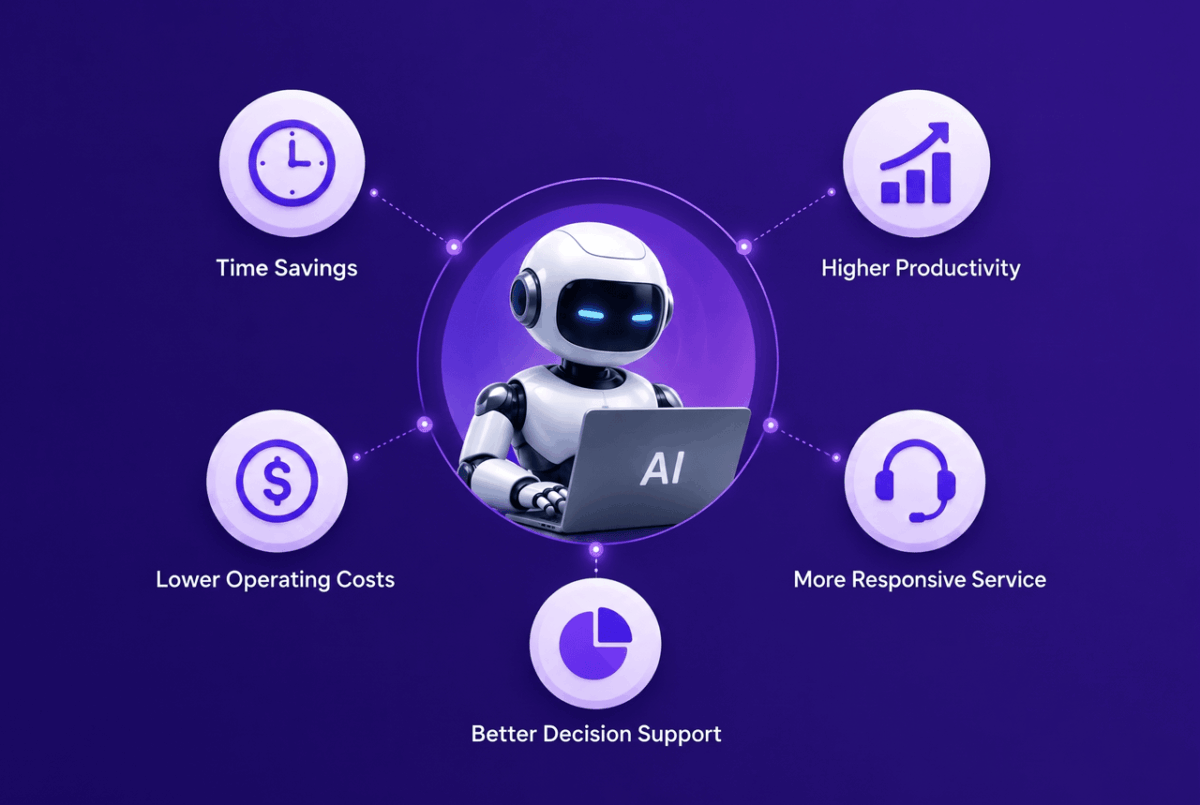
The clearest gains come from improving a specific process.
- Time Savings: Routine follow-ups, summaries, scheduling, sorting, and data transfers require less manual work.
- Lower Operating Costs: Automation can reduce rework and shift employee time toward higher-value activities.
- Higher Productivity: Teams can complete research, preparation, and documentation faster.
- More Responsive Service: Automated systems can acknowledge requests immediately and route complex cases.
- Better Decision Support: AI can organize data and surface trends for managers to review.
For many companies, the goal is helping a lean team operate with fewer bottlenecks.
AI Business Solutions Every Small Business Should Consider
The most useful AI business solutions connect directly to recurring work that already consumes time or delays customers.
Customer Support Automation
AI chatbots and support agents can answer common questions, provide order updates, collect initial details, and operate outside regular business hours. Platforms such as Intercom and Zendesk combine automated interactions with escalation to human agents.
Marketing Automation
AI can assist with email drafts, audience segmentation, campaign variations, content repurposing, social scheduling, and personalized recommendations. It works best when it supports a defined marketing strategy rather than simply increasing content volume.
Sales and CRM Automation
Sales teams can use AI to summarize calls, score leads, suggest follow-ups, and forecast pipeline activity. HubSpot Breeze and Salesforce Einstein use CRM data to support qualification, outreach, recommendations, and forecasting.
Administrative and Back-Office Tasks
Scheduling, invoice intake, data entry, approval routing, and status updates are often strong first projects. Zapier, for example, can connect thousands of applications so information moves between forms, email, calendars, accounting tools, and CRMs.
How an AI Assistant for Small Business Improves Daily Operations
A well-configured AI assistant for small businesses connects employees with the information and workflows they use every day.
It can draft customer responses, find meeting times, turn notes into assigned tasks, summarize documents, retrieve approved procedures, and prepare routine reports for review.
The best assistant is the one connected to reliable information, appropriate permissions, and tools employees already use.
Best AI Tools for Business in 2026
The best AI tools for businesses depend on the process, technology stack, data sensitivity, and required oversight.
Customer Support Tools
Intercom Fin and Zendesk AI suit companies with meaningful support volume. HubSpot’s customer agent may fit businesses already using its CRM. Compare escalation controls, channels, reporting, and pricing.
Content Creation Tools
ChatGPT Business, Claude for Work, Gemini, and Canva Magic Studio can support research, drafting, summarization, presentations, and visual production. Business plans may provide stronger administrative and data controls than consumer accounts; OpenAI, for example, states that it does not train on ChatGPT Business workspace data.
Marketing Automation Platforms
HubSpot and Mailchimp combine campaign automation with AI-assisted content and analytics. Choose based on customer data, campaign complexity, integrations, and reporting, not the length of the AI feature list.
Productivity and Collaboration Tools
Microsoft 365 Copilot and Gemini for Google Workspace bring AI into familiar email, documents, spreadsheets, and meetings. ChatGPT Business and Claude can provide broader assistance across multiple functions.
CRM and Sales Automation Solutions
HubSpot Breeze and Salesforce Einstein support lead scoring, customer intelligence, outreach, forecasting, and workflow automation. Smaller teams should first review the AI features already available in their CRM.
The Role of AI Consulting for Small Businesses
Buying tools is easier than selecting the right process, preparing data, and integrating the system responsibly.
AI consulting for small businesses provides the most value when a company has several potential use cases, disconnected systems, sensitive data, or custom integration needs. A consultant can help map workflows, compare vendors, connect systems, establish review controls, train employees, and measure return on investment.
Consulting is less necessary for a simple, low-risk workflow already supported by an existing platform. It matters more when AI influences customer communication, financial processes, regulated data, or core operations.

Industries Benefiting Most From AI Automation
Retail and e-commerce businesses use AI for recommendations, inventory signals, support, and personalization. Professional services firms apply it to intake, research, documents, and scheduling. Hospitality companies automate guest communication, while real estate teams qualify inquiries and organize property data. Financial and healthcare organizations can improve administrative work but need stricter privacy and approval controls.
The strongest opportunity appears where similar information moves through a repeatable workflow.
Challenges to Consider Before Implementing AI
AI adoption introduces costs and responsibilities that a software demo may not show.
- Initial Investment: Integration, data cleanup, training, and oversight add to subscription costs.
- Data Privacy and Security: Businesses need to know what data a tool receives, stores, and uses.
- Employee Adoption: Staff may reject systems that add steps or produce unreliable output.
- Legacy Integration: Older platforms may lack APIs or consistent data.
- Human Oversight: AI can produce inaccurate or inappropriate outputs, especially in high-stakes work.
Automation should reduce operational risk, not hide it behind a faster interface.
Best Practices for Successful AI Adoption
A disciplined rollout makes results easier to measure and problems easier to correct.
- Start With One Process: Select a recurring task with clear inputs, outputs, and ownership.
- Set Measurable Goals: Track response time, hours saved, error rate, conversion rate, or cost per transaction.
- Choose Scalable Solutions: Review integrations, permissions, reporting, and pricing before expansion.
- Train Employees: Explain where AI helps, where it can fail, and when review is mandatory.
- Monitor and Improve: Review outputs, exceptions, feedback, and business results regularly.
Automate the stable process first. Automating a poorly documented process usually creates faster confusion.

The Future of AI Automation for Small Businesses
The next phase will be less about isolated chat windows and more about AI embedded in everyday systems.
Customer experiences will become more personalized as businesses connect AI to approved data. Assistants will coordinate multistep tasks, while predictive analytics and document interpretation become easier to use inside everyday platforms.
The lasting advantage will come from better processes, better data, and stronger employee judgment, not adoption alone.
Turning AI Into Practical Business Value
AI automation for small businesses is most useful when it removes a real constraint: slow response times, repetitive administration, missed follow-ups, fragmented data, or limited visibility.
The right starting point is one practical workflow with a measurable outcome and a clear human owner. Once it performs reliably, the business can expand with greater confidence.
Our team at Digilite helps U.S. businesses evaluate, design, and integrate digital solutions that fit their operations rather than forcing them into a generic toolset. Start with the process costing your team the most time, then build the right solution around it.