
We’ve all been there: staring at a mountain of repetitive workflows and wishing the software could just… handle it. Well, that “someday” is finally here. In 2026, AI agents are doing more than just reasoning; they’re taking action.
Whether it’s streamlining complex operations or bridging the gap between data and execution, these systems are the new gold standard for business efficiency. But what’s actually happening under the hood? Let’s dive into the world of autonomous systems and explore the trends driving this massive shift.
What is an AI Agent in Business Software?
A classic AI definition frames an agent as something that perceives its environment and acts within it to achieve goals rather than only producing text.
In enterprise terms, “environment” typically means:
- enterprise applications (CRM, ERP, HRIS, ITSM, SCM),
- collaboration systems (email, calendars, chat),
- data stores (knowledge bases, data warehouses),
- and operational signals (tickets, alerts, transactions).
AI Agents vs. Agentic AI vs. Autonomous AI systems
- AI agent (system level): A software system that combines an AI model with tools, memory/state, and control logic so it can complete tasks end-to-end (e.g., “resolve a billing dispute,” “create a post-incident report,” “draft and open a pull request”).
- Agentic AI (capability level): The capability of AI-driven software to set sub-goals, plan, and take steps toward outcomes, often with delegation and handoffs. In practice, agentic AI is less about a single model and more about an architecture that reliably “turns reasoning into actions.”
- Autonomous AI system (operating model level): An agent or set of agents that can operate with reduced human prompting and higher operational independence, typically bounded by policies: permissions, risk thresholds, and escalation rules. Autonomy is not binary; production systems usually land on supervised autonomy (human-in-the-loop for high-risk actions).
Assistants vs. Agents (and Why “Agentwashing” Matters)
A strong 2026 distinction is between:
- AI assistants that facilitate user interaction with software (drafting, Q&A, summaries)
- AI agents that can take actions (API calls, workflow steps), persist state over time, and operate under governance controls.
This matters because many programs fail when leaders expect “autonomous execution” but deploy a tool that is essentially chat + automation glue. That gap is a major driver of inflated expectations, weak measurement, and early cancellations.
The 2026 Landscape: Adoption Signals and Market Size
Enterprise applications are embedding agents fast. A widely-cited analyst prediction is that 40% of enterprise applications will feature task-specific AI agents by 2026 (up from <5% in 2025).
But many agent projects will still fail without discipline. Another analyst prediction: over 40% of agentic AI projects are expected to be canceled by the end of 2027, commonly due to escalating costs, unclear value, or inadequate risk controls.
Survey data shows the “agent curiosity ↔ scaling gap.” In a global survey of ~2,000 respondents, 23% reported scaling an agentic AI system somewhere in the enterprise, while another 39% reported experimenting with AI agents (i.e., beyond “interest,” but not scaled).
The same survey also reports that no individual business function exceeds 10% scaling for AI agents, suggesting that 2026 is still the year of selective scaling, not broad saturation.
Adoption by Function: Where Agents are Scaling First
Below is a chart of where organizations report scaling AI agents by function, which is a useful proxy for “where agentic workflows are productionizing first.”
Interpretation for business leaders and product teams:
- IT and knowledge management lead because the systems are already ticket- and document-driven, and success criteria are measurable (resolution time, deflection rate, retrieval accuracy).
- Marketing/sales and service operations follow because they have high-volume workflows and clear “next actions” (create a case, update a record, send a follow-up).
- Supply chain and manufacturing lag in scaling despite strong long-term potential, largely because tool integration, exception handling, and safety constraints are harder.
Market Size: What “AI Agents” Mean in Forecasts
Market sizing is messy because analysts define “AI agents” differently:
- Some count agent platforms and agent orchestration software,
- Others include conversational AI, automation, or broader autonomous systems.
A representative market estimate projects the AI agents market growing from $7.84B (2025) to $52.62B (2030), ~46% CAGR. A second estimate (different segmentation) states a $5.7B base year (2024) and projects $48.3B by 2030 (~43% CAGR).
The Enabling Tech Stack: Models, Tools, Orchestration, and Architecture
The “Agentic Loop” Is The Product
An enterprise agent is not one model call. It is a closed-loop control system:
- interpret the goal (intent and constraints),
- plan steps,
- call tools (APIs),
- observe results,
- update state,
- decide whether to continue, escalate, or finish, while logging everything.
If your agent platform can’t do this reliably, you don’t have autonomy; you have a chat UI.
Key Technologies Enabling Agents In 2026
- Foundation models (LLMs and multimodal FMs). These provide the reasoning and natural language interface, but must be bounded by retrieval, tools, and policy to be production-grade.
- Alignment and reinforcement learning (RLHF variants). RLHF-style training is a key method used to make models follow instructions and reduce harmful outputs, which matters when models are placed behind tool execution.
- RAG (retrieval-augmented generation). RAG improves factual grounding by retrieving relevant enterprise documents at runtime and conditioning the model on them. It’s foundational for “policy-aware” and “process-aware” agents.
- Tool calling/function calling. This is how agents “act”: models output structured tool calls, the system executes the tool, and the result is fed back into the model loop.
- Reasoning and acting patterns (ReAct and successors). Interleaving reasoning traces with actions is a core approach behind tool-using agents (including in managed enterprise offerings).
- Orchestration engines. Production agent workflows need durable execution, retries, idempotency, and human approvals –capabilities traditionally handled by workflow engines. Cloud guidance explicitly frames “workflow orchestration agents” as a pattern for coordinating multistep tasks across distributed systems.
- Standardized tool/data connectivity. A major trend is standard protocols that let agents connect to tools and data sources without bespoke integrations. The Model Context Protocol (MCP) is one prominent example, positioned as an open standard for connecting AI systems to the systems where data lives.
Reference Architecture For Enterprise Agents
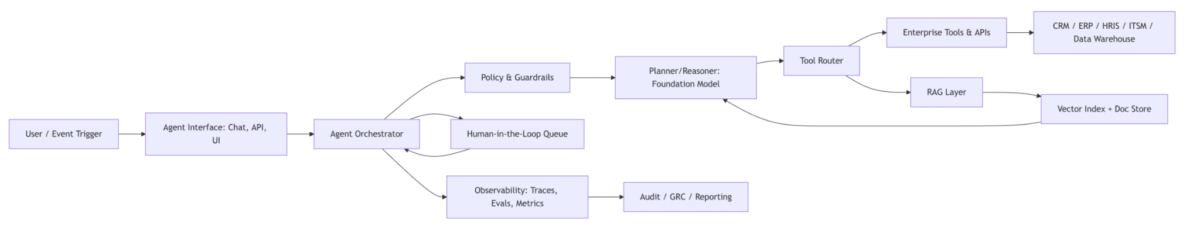
What makes this architecture “enterprise-grade” is control and evidence:
- policy gates before sensitive actions,
- identity and access mapped to real enterprise permissions,
- retrieval grounded in approved data sources,
- and observability that supports audits, debugging, and ROI measurement.
Business Applications
Case Studies and Published Results
| Function | Example | What the agent did | Outcome (as reported) |
| Software development | GitHub(Copilot study) | Assisted developers while implementing a defined programming task in a controlled experiment | 55.8% faster task completion(treatment vs control). |
| Customer support | Call-center conversational assistant (field study) | Suggested responses and operational knowledge to support agents during customer interactions | ~15% higher issues resolved per hour on average (with stronger gains for less-experienced workers). |
| Customer service | Klarna | Automated large portions of customer service chat, resolving issues and reducing repeats | 2.3M conversations in first month and ~two-thirds of customer service chats; 25% drop in repeat inquiries; <2 minutes vs 11 minutes to resolve; $40M profit improvement estimate (2024). |
| Finance / advisor workflow | Morgan Stanley(Debrief + internal assistant) | Generated meeting notes and action items (with client consent), drafted follow-ups, and saved notes into CRM; used internal content controls | Debrief generates notes/action items and saves a note into Salesforce; internal assistant uses GPT-4 constrained to internal content with controls. |
| IT operations | ServiceNow(ITSM agents) | Agentic workflows for post-incident reporting and change planning inside ITSM | Example use cases include post-incident reporting and change request planning via ITSM agent collections. |
| HR shared services | HR case assistance (Now Assist HRSD) | Summarized HR cases/chats, suggested resolutions, generated fulfillment plans, and assisted with tuition reimbursement workflows | Documented HR agent use cases include tuition reimbursement processing and fulfillment plan generation for HR cases. |
Example Workflow: An Agent That Resolves a Billing Dispute Safely
Below is a reference design showing how “assist → act” becomes production automation, with explicit controls.
Step-by-step workflow:
- Trigger: a dispute ticket is created (portal/chat/email) with a user identity.
- Classify: agent identifies dispute type and required evidence (policy + account context via RAG).
- Retrieve context: pulls the relevant policy, transaction record, and recent customer interactions.
- Propose plan: agent drafts a plan with decision points (eligibility, fraud signals, thresholds).
- Tool actions: calls payment/refund APIs and updates CRM/ITSM fields if policy allows.
- Human approval gate: if the amount exceeds the threshold or signals are ambiguous, route to an agent queue with a ready-to-approve packet.
- Notify + log: send customer confirmation, record actions, and attach evidence trail for audit.
Benefits, ROI, and the Metrics That Actually Predict Value
What Benefits Are Real (And Measurable) in 2026?
The most defensible benefits fall into four buckets:
- Productivity and cycle-time reduction – Multiple studies show productivity gains in targeted tasks, e.g., faster software task completion in controlled experiments, and higher throughput in customer support settings.
- Quality and consistency – In support workflows, research suggests larger improvements for less-experienced workers, interpretable as “best-practice diffusion” via the model’s suggestions.
- Cost reduction through automation + deflection – Analyst forecasts explicitly tie agentic automation to operational cost reduction in service contexts in the coming years.
- Time-to-value in knowledge work – Document-heavy domains (wealth management, research, compliance) benefit when agents retrieve, summarize, and produce structured next steps, but only when grounded in internal sources and evaluated.
ROI: A Practical Model For Agentic Workflows
You can estimate ROI with a simple, decision-ready framework:
- Annual benefit = (time saved × fully loaded cost) + (error reduction × cost of error) + (deflection × cost per ticket) + (revenue lift × gross margin)
- Annual cost = platform fees + model usage + integration/engineering + governance/compliance + change management + ongoing tuning/monitoring
A useful executive pattern from survey data: organizations report use-case-level benefits(cost and revenue) more often than enterprise-wide EBIT impact, meaning you should treat agents as a portfolio of measurable workflows, not a single transformation bet.
Example (real-world reported economics): one company announcement estimated a $40M profit improvement tied to its AI assistant’s impact (including deflection and productivity).
Metrics That Predict Successful Scale
If you track only one set of metrics, track these:
- Task success rate (end-to-end completion without human rework)
- Escalation rate (how often humans must intervene) and why
- Cost per completed task (model, tools, and labor), not cost per message
- Time-to-resolution / cycle time for the workflow
- Grounding quality (retrieval precision, citation coverage, policy match)
- Safety and compliance KPIs (blocked unsafe tool calls, permission denials, audit exceptions)
Implementation Roadmap and Outlook to 2030
Phase 1: Pick a workflow, not a department. Choose one end-to-end process (e.g., refund resolution, change request planning, onboarding documentation) with clear start/end states and measurable outcomes.
Phase 2: Build the minimal agent that can safely act. Start with:
- a narrow tool set,
- small retrieval scope,
- explicit policy prompts,
- and a human approval gate for sensitive steps.
Phase 3: Instrument measurement from day one. Before expanding, prove:
- task success rate,
- cost per completed task,
- escalation reasons,
- and safety violations blocked.
Phase 4: Scale by cloning patterns, not by copying prompts. Use reusable components:
- tool schemas,
- policy templates,
- test suites/evals,
- and observability dashboards.
Phase 5: Operationalize change management. Train frontline teams on:
- when to trust vs verify,
- how to escalate correctly,
- and how agent outcomes map to KPIs.
AI agents are revolutionizing business operations by automating workflows, reducing costs, and increasing productivity. As enterprises increasingly adopt these technologies, the future of business applications will rely on seamless integration and precise implementation for optimal results.