

Every week, another company announces an ambitious AI initiative. Most will quietly disappear. Here’s the unfiltered truth and the exact playbook to avoid joining the graveyard.
The Reality of AI Projects in 2026
The boardroom is full of energy. The budget is approved. The vendor demo looks impressive. But 18 months later, the project is quietly shelved, leaving behind a drained budget and a frustrated team, with little to show for it.
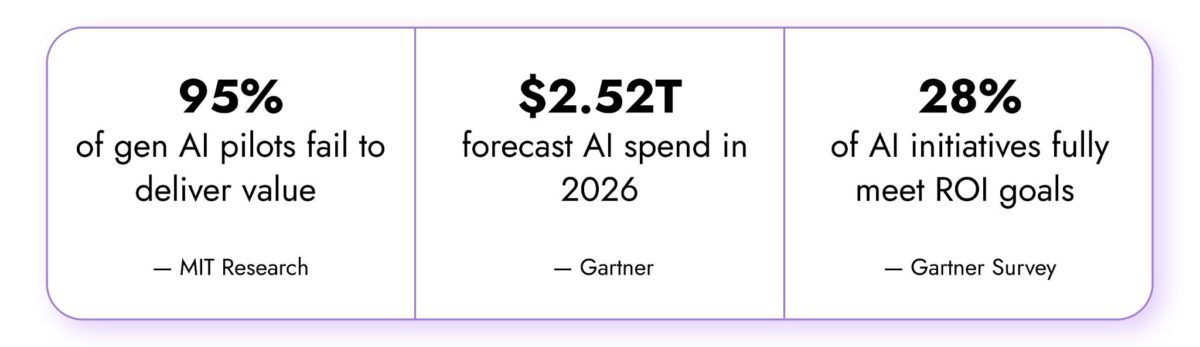
This isn’t a rare story. According to Gartner’s latest research, only 28% of AI initiatives fully meet ROI expectations, while 20% fail outright. The remaining half are stuck in the grey zone of partial results and broken promises. And Gartner itself is now watching generative AI slip into what analysts call the “Trough of Disillusionment,” where hype crashes into operational reality.
The good news? Failure is rarely about the technology itself. It’s about strategy, preparation, and execution. That means it’s entirely preventable if you know what to look for.
Why Most AI Projects Fail: The 6 Real Reasons
Let’s go over the 6 common AI implementation mistakes:
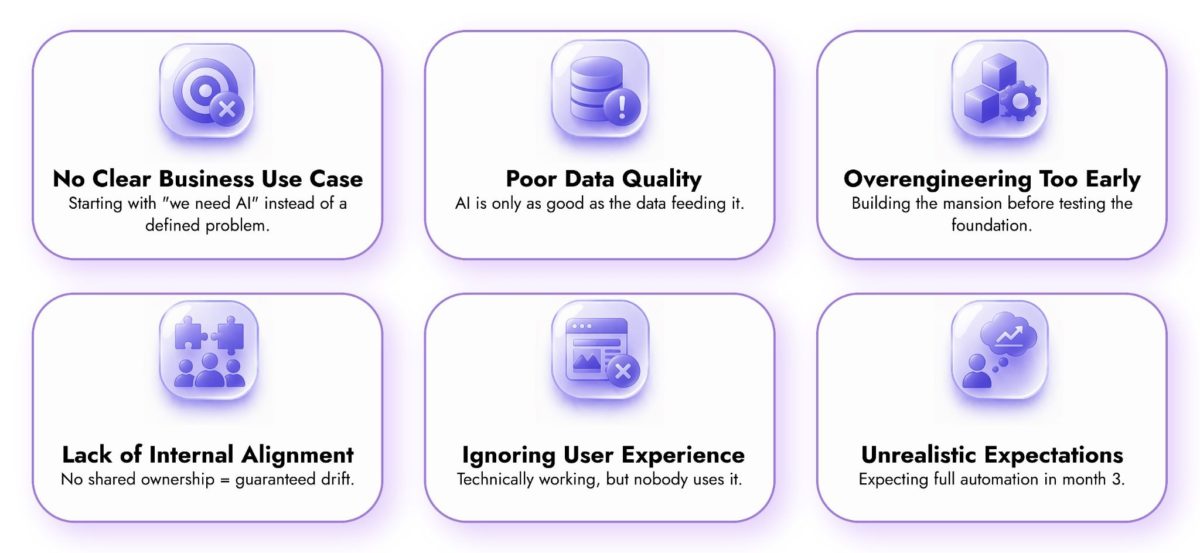
1. No Clear Business Use Case
This is the biggest mistake: jumping into AI because it’s “cool” or because others are doing it, without first defining a clear business problem to solve. For example, businesses often try to implement chatbots without clarifying the specific customer service tasks they aim to improve, which results in underperforming systems that don’t meet expectations.
Example: A company might think, “Let’s implement an AI chatbot for customer support,” without identifying what part of the customer experience needs improvement, leading to confusion and poor adoption.
The fix: Start with the problem, not the solution.
2. Poor Data Quality or No Data Strategy
AI runs on data, and if your data isn’t clean, structured, or reliable, your AI model will struggle. A lack of data strategy, or not having the right data, is a surefire way to kill your AI project before it even gets off the ground.
Example: Imagine trying to implement AI in a customer segmentation process using incomplete or outdated customer information. The result? Your AI model won’t accurately segment your audience, wasting time and resources.
The fix: Before building anything, audit your data. Can you export it cleanly? Is it consistent? Is there enough of it? If the answer to any of these is “not really,” fix the data first.
3. Overengineering Too Early
Trying to build complex AI systems without validating them can backfire. The key is to start simple, get a Minimum Viable Product (MVP) off the ground, test it, and refine it before going all-in.
Example: A company might create a complex AI system for recommending products on their website, only to realize that a simpler version of the algorithm could have worked just as well for a while.
The fix: Use an existing API (OpenAI, Claude, Gemini) to validate the concept in 2-4 weeks before investing in custom infrastructure. The MVP approach consistently outperforms moonshot builds.
4. Lack of Internal Alignment
AI implementation requires a lot of teamwork. When leadership, tech teams, and operations are not on the same page, things can fall apart quickly. Misalignment can lead to missed deadlines, poor communication, and a lack of ownership.
Example: Engineering built a document automation tool, but operations wasn’t consulted. The workflow it automates has been changed twice since the project started. The tool ships and immediately needs a full redesign.
The fix: Assign a business owner, not just a tech lead. Every AI project needs someone who owns outcomes, not just someone who owns the code.
5. Ignoring User Experience
Even if your AI system is technically perfect, it won’t work if users find it difficult to use. Low adoption rates often stem from poor user interface (UI) design or overly complex functionality that confuses end users.
Example: A chatbot with a great back-end AI system might fail if it’s too hard for users to interact with it or if it doesn’t meet their expectations for simple communication.
The fix: AI features must reduce friction, not add it. If users need training to operate your AI tool, it’s not ready. Test with real users early and often.
Personalization is one area where good UX and AI genuinely compound. See how AI-driven personalization is changing e-commerce customer experience.
6. Unrealistic Expectations
AI isn’t magic; it won’t solve all your problems overnight. Expecting too much, too soon, is a recipe for disappointment. It’s important to set realistic goals and manage expectations from the start.
Example: Expecting an AI tool to fully automate your customer support system within a month without considering the time it will take to train the model and gather feedback will lead to frustration.
The fix: Define success in stages. What does a successful month 1 look like? Month 6? Year 2? AI is a process, not a switch you flip.
Hidden Costs That Kill AI Projects
AI is not a one-time investment. Beyond development, there are high long-term costs that businesses often overlook, such as:
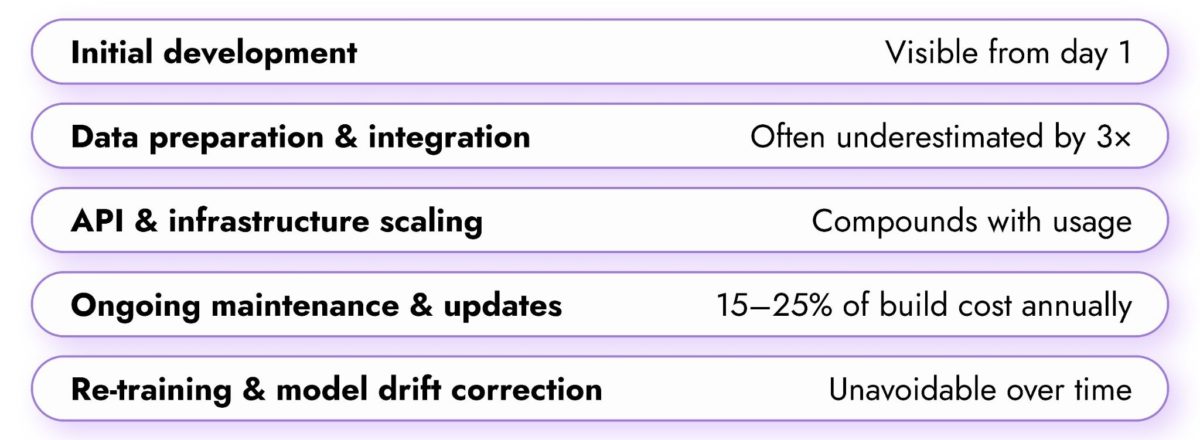
The bars above illustrate relative weight, not a fixed formula. Every project is different. What matters is that none of these lines is zero. Budget for all of them before you start.
What Successful AI Projects Do Differently
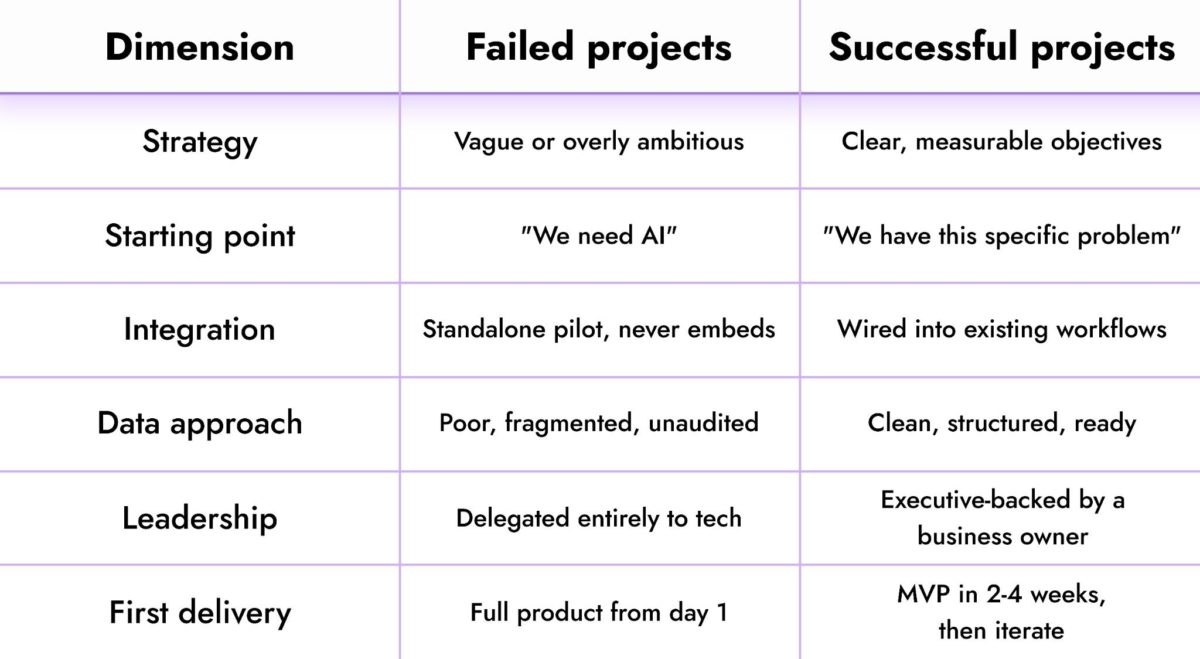
1. Start with a Clear, Measurable Goal
Successful AI projects focus on measurable business outcomes. Instead of “let’s implement AI,” they ask, “How can AI reduce customer response times by 50% or increase conversion rates by 20%?”
2. Build an MVP First
Before building complex AI systems, start small. Test your ideas with an MVP, validate them with real users, and refine based on feedback.
3. Choose the Right AI Approach
AI isn’t a one-size-fits-all solution. There are different approaches, API-based solutions, custom-built models, or automation workflows. Select the option that best suits your company’s requirements.
4. Focus on Real User Problems
AI should be a tool to solve real problems. It’s better to build a system that’s simple, intuitive, and effective rather than over-engineered and complex.
5. Iterate and Improve Continuously
AI is not a technology that can be “set and forgotten.” It needs to be continuously improved and updated based on real-world usage.
Customer Support Chatbot Examples: Same Goal, Opposite Outcomes
Two companies. Both wanted an AI-powered customer support system.
Failed Approach (Company A: Built First, Thought Later)
Let’s say a mid-sized e-commerce company hired an agency to build a “full AI support system.” The brief was vague: replace the support team.
- Budget: €180K.
- Timeline: 4 months.
The system was built on custom NLP models trained on 6 months of old tickets. It couldn’t handle returns, multilingual queries, or anything off-script. Customers didn’t like it. The company reverted to manual support after 8 weeks.
- €180K spent
- 8 weeks in production
- 0% of support for automated
- NPS dropped 12 points
Successful Approach (Company B: Started Small, Scaled Smart)
A similar company mapped their top 20 support query types first. They built an MVP in 3 weeks using an existing AI API, handling just order tracking and FAQs. Adoption was tested with 10% of users.
After iteration, they expanded to returns, refunds, and multilingual support. Human agents were kept for complex cases.
- €40K initial build
- 3-week MVP
Would you like to witness this in action? We broke down how AI is reshaping customer experience in e-commerce; read our deep dive on AI-powered e-commerce mobile apps.
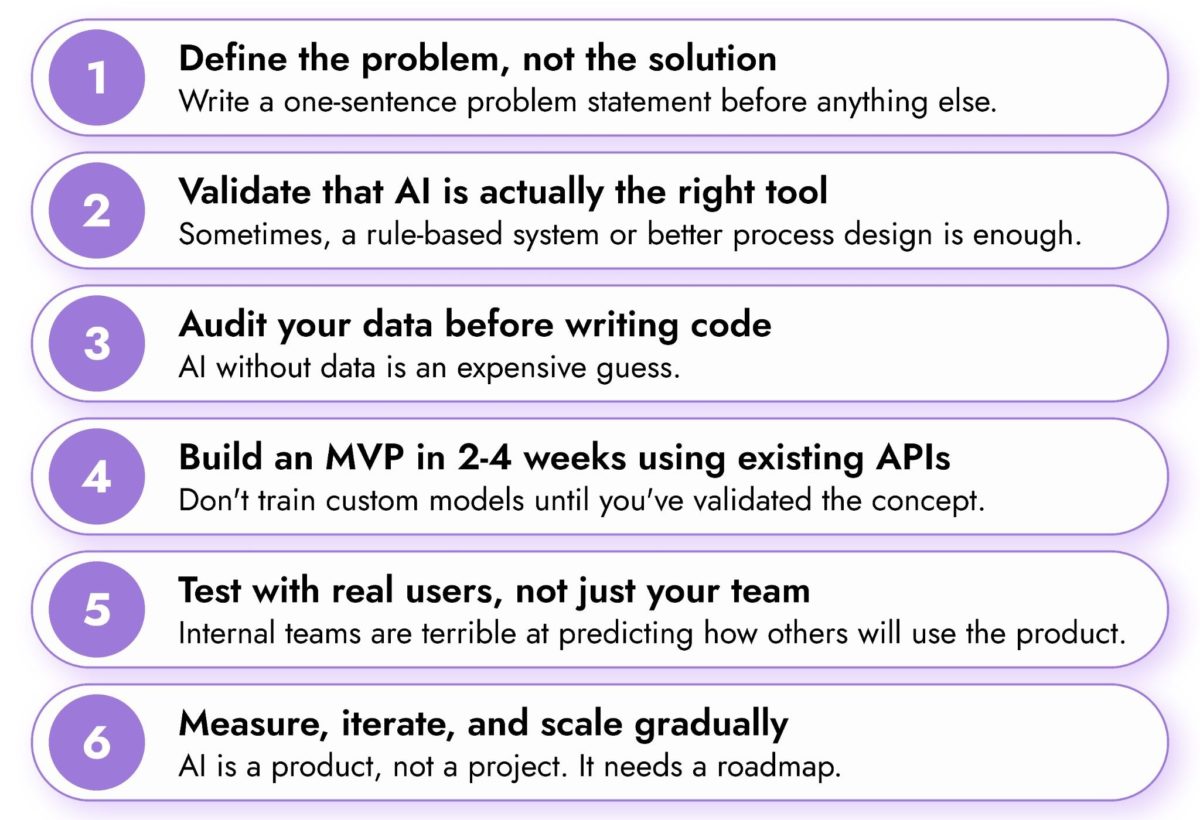
How to Make Your AI Project Work (Step-by-Step)
Let’s go over the steps on how to implement AI successfully.
When AI Is Not the Right Solution
One of the most valuable things a good AI partner can do is tell you when you don’t need AI. Here are the situations where simpler solutions win:
Skip AI when…
- Your process is already simple and low-volume; basic automation (Zapier, Make) will handle it faster and cheaper.
- You don’t have usable historical data; you can’t train or fine-tune a model in the air.
- The decision has zero tolerance for error, medical diagnoses, legal filings, and financial approvals. AI assists here; it doesn’t decide.
- Your business process isn’t documented or stable; automating a broken or changing process just breaks faster.
- The team isn’t bought in; an AI tool with no internal adoption is just an expensive demo.
Key Takeaways
✓ Most AI failures are strategic, not technical. The model isn’t the problem; the brief, the data, and the alignment are.
✓ Start small and validate before you scale. An MVP built in 3 weeks teaches you more than a 6-month build.
✓ Define success before you start. If you can’t measure it, you can’t improve it, and you can’t defend the budget.
✓ Integration beats sophistication. AI embedded in daily workflows drives ROI. Standalone pilots just drive headlines.
✓ Treat AI as an ongoing process, not a one-time project. The companies winning with AI have roadmaps, not launch dates.
✓ Autonomous AI agents are already changing how businesses operate in 2026.